Saturday, September 20, 2008

Kiowa Pochoir Prints

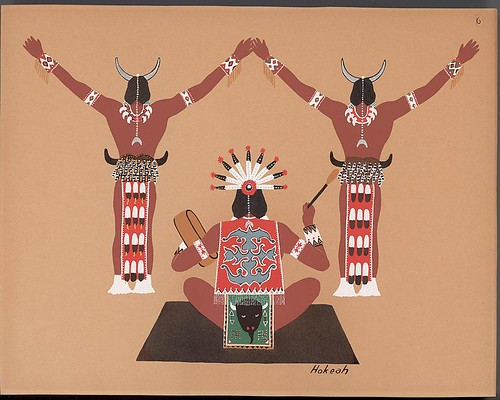
Greeting of the Moon God, 1929 - Jack Hokeah

Greeting of the Moon God by Jack Hokeah
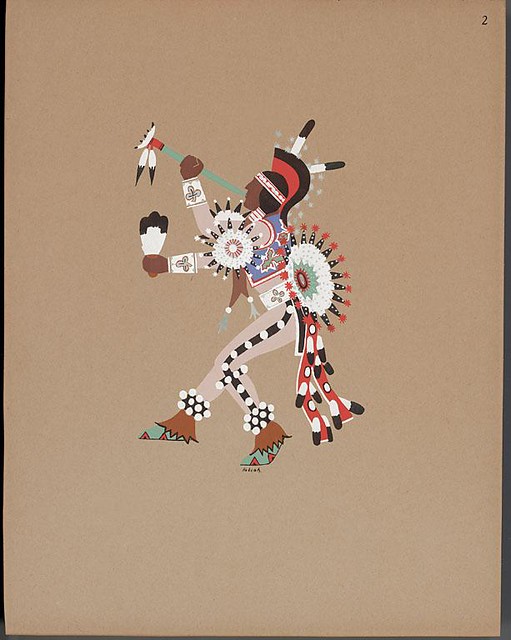


Hummingbird dance, 1929 - Jack Hokeah

Hummingbird Dance by Jack Hokeah
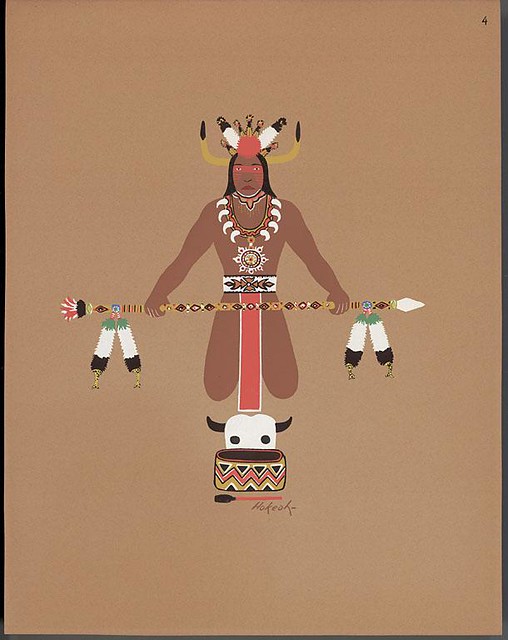


native American pochoir print by Jack Hokeah

Kiowa Priest in Prayer by Jack Hokeah
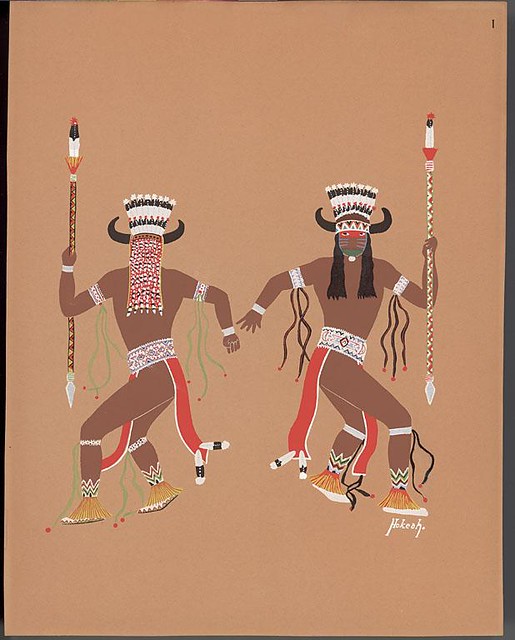


Buffalo dance, 1929 - Jack Hokeah

Buffalo Dance by Jack Hokeah
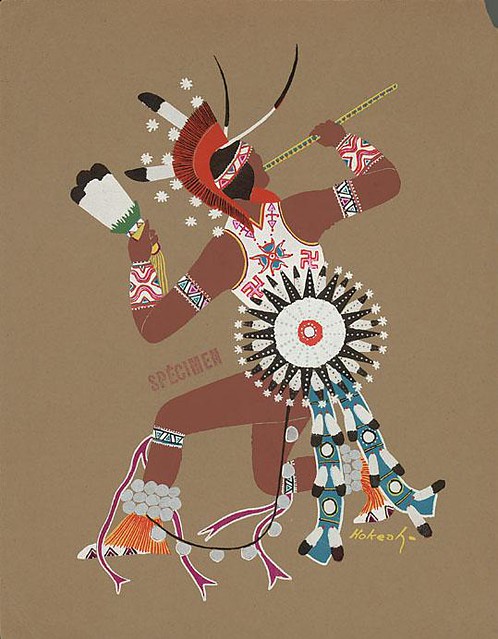


pochoir print of American Indian dance ritual by J Hokeah

Ceremony Dance by Jack Hokeah


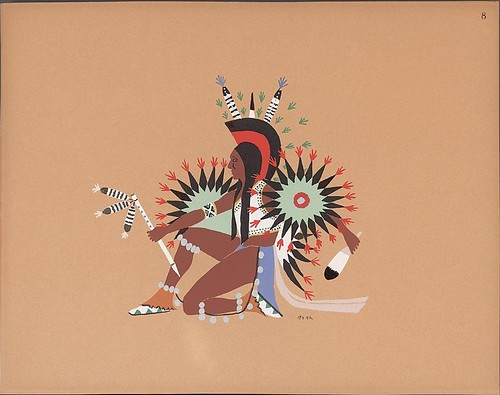
Self portrait dancing, 1929 - Spencer Asah

Self portrait dancing by Spencer Asah
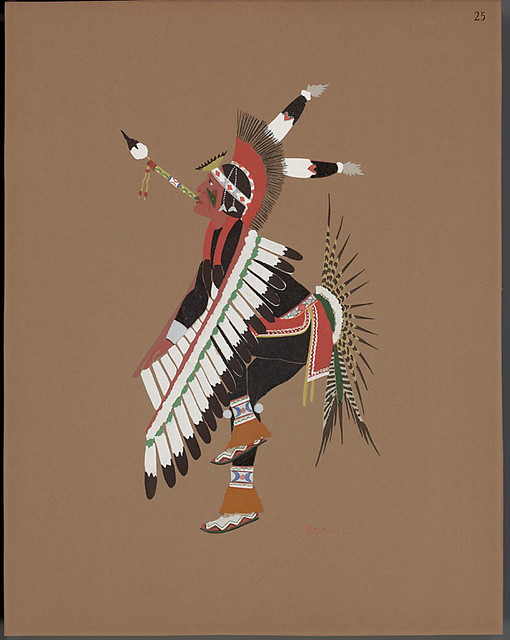


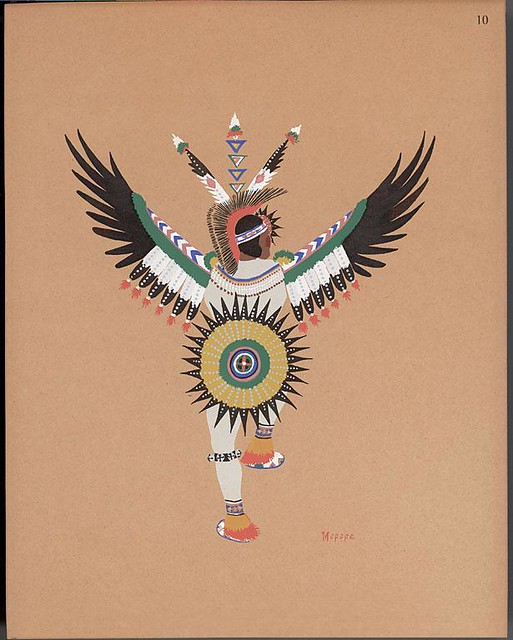
Eagle dance, 1929 - Stephen Mopope

Eagle Dance by Stephen Mopope
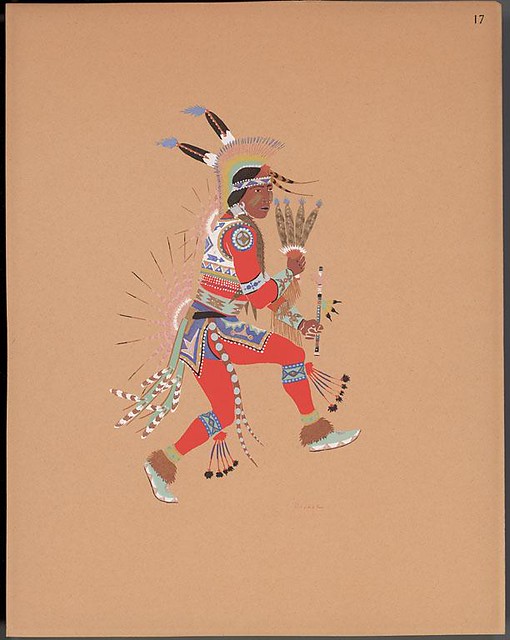


1929 colour print of American Indian Eagle dance

Eagle Dance by Stephen Mopope


illustration of native American in traditional costume with flute

Flute Player by Stephen Mopope


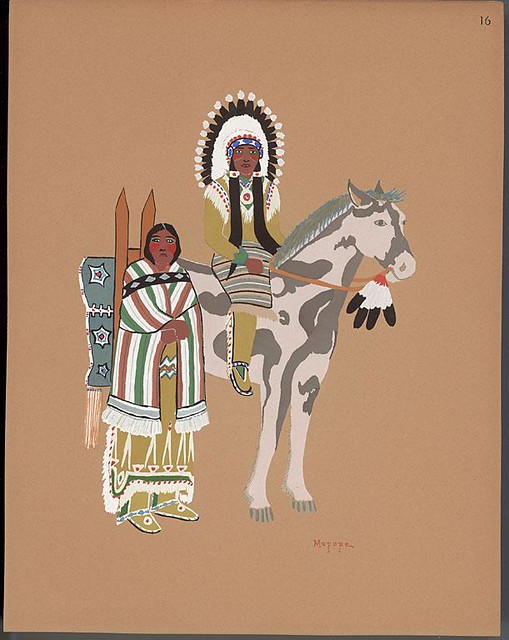
Kiowa warrior on horse and wife standing by : American Indian print, 1929 - Stephen Mopope

Kiowa Warrior and Wife by Stephen Mopope
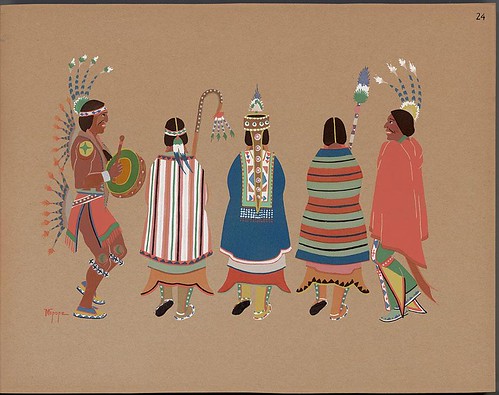


Squaw dance - native American illustration

Squaw Dance by Stephen Mopope


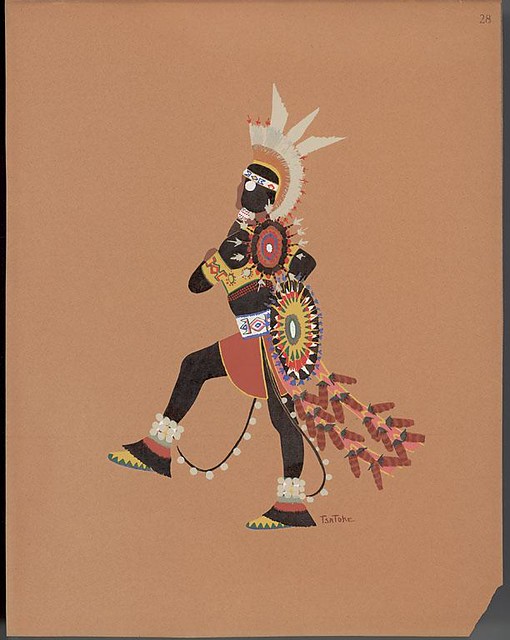
Medicine dance, 1929 - Monroe Tsatoke pochoir print

Medicine Dance by Monroe Tsatoke


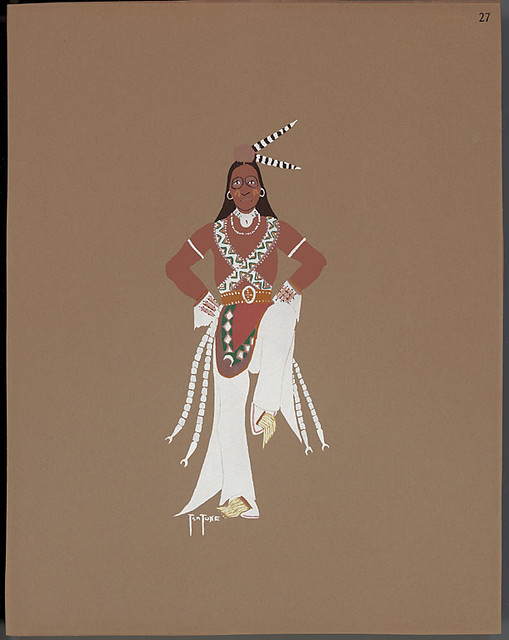
Warrior wearing black clothing, 1929 - illustration by Monroe Tsatoke

Warrior Wearing Black Clothing by Monroe Tsatoke
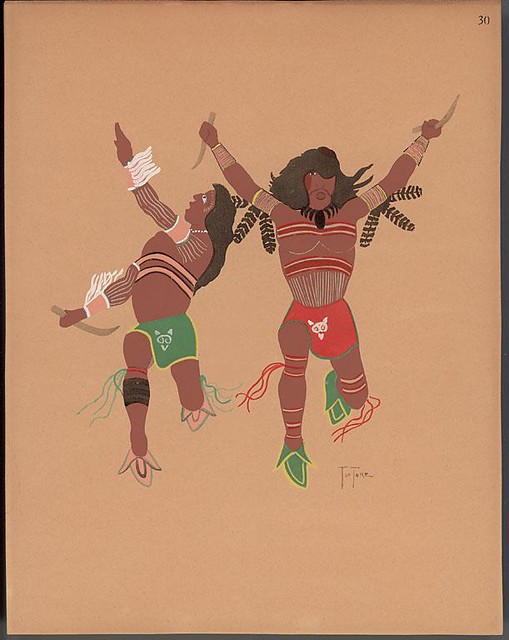


pochoir illustration of 2 native American Warriors in dynamic pose 1929 - Monroe Tsatoke

Warriors by Monroe Tsatoke


[All images © the Estate of the respective artist]


"The Kiowa Five were a group of painters who earned national and international acclaim during the early twentieth century. The group actually consisted of six individuals, Spencer Asah, Jack Hokeah, Stephen Mopope, Monroe Tsatoke, Lois Smoky, and James Auchiah.

A number of the artists attended St. Patrick’s Mission School in Anadarko, Oklahoma, where they received art instruction from Sister Olivia Taylor. Susan Peters, a government field matron, also took an interest in the young artists' work. She arranged for an artist from Chickasha, Mrs. Willie Baze Lane, to provide art lessons. Eventually Ms. Peters persuaded Dr. Oscar Jacobson, head of the school of art at the University of Oklahoma, to provide additional training for the artists.

In 1926, Asah, Hokeah, Tsatoke, and Mopope arrived at the University. The artists were not officially enrolled, but they received special instruction from Jacobson and Dr. Edith Mahier, another professor in the school of art. In January 1927, Lois Smokey, a young Kiowa woman, arrived to study with the other artists. In spring, the artists were compelled to return home to attend to agricultral pursuits. They returned in the fall, accompanied by James Auchiah, the sixth and final student. Shortly thereafter, Lois Smokey withdrew from the program and returned home.

Dr. Oscar Jacobson arranged for the Kiowa artists’ paintings to be exhibited in 1928 at the First International Art Exposition in Prague, Czechoslovakia. In 1929, Kiowa Art, a portfolio of the artists' paintings was published in France."
Jack Hokeah was born in 1902 in western Oklahoma. He attended St. Patrick's Mission School in Anadarko, Oklahoma. He died on December 14, 1969.

Spencer Asah also known as Lallo (Little Boy) was born between 1905 and 1910 near Carnegie, Oklahoma. He attended various government Indian schools and St. Patrick's Mission School, Anadarko, Oklahoma. He died in 1954.

Stephen Mopope also known as Qued Koi (Painted Robe) was born on August 27, 1898 near Red Stone Baptist Church on the Kiowa Reservation. He attended St. Patrick's Mission School in Anadarko, Oklahoma. He died on February 3, 1974.

Monroe Tsatoke also known as Tsa To Kee (Hunting Horse) was born September 29, 1904 at Saddle Mountain, Oklahoma. He attended Rainy Mountain Indian School near Carnegie, Oklahoma and Bacone College. He died on February 3, 1937.

Friday, September 19, 2008

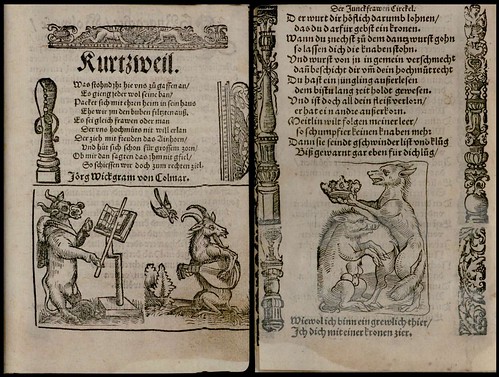
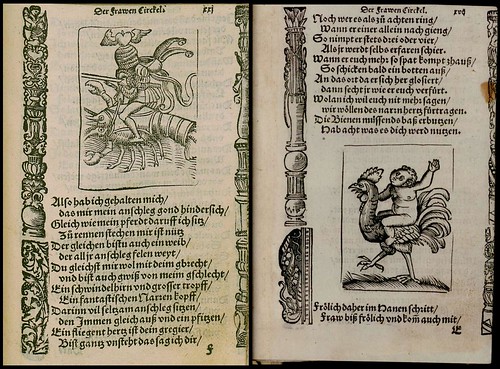
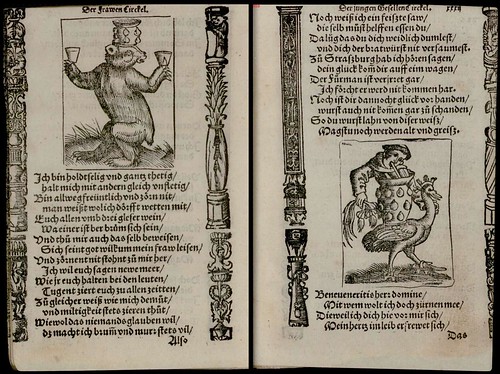
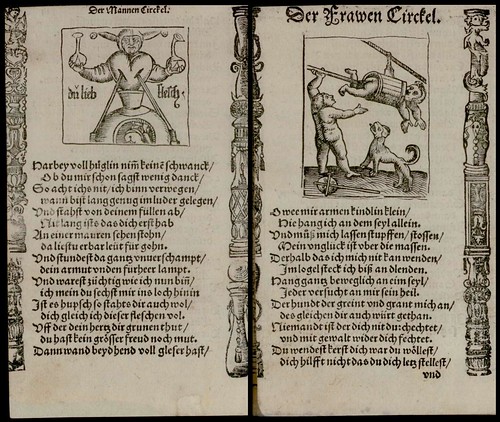
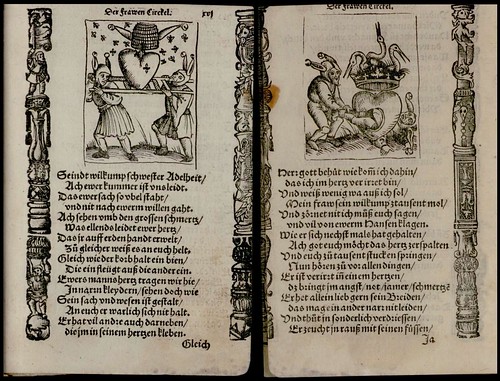
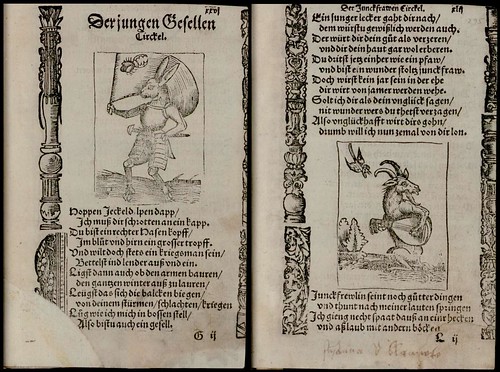
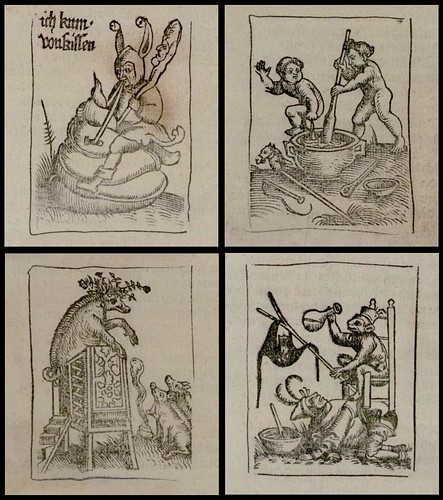
Kurtzweil Satires

woodcuts: cow conductor + goat on flute AND wolf crowns pig


woodcut illustrations: knight rides lobster + child rides rooster


dancing bear and friar in vase riding a bird


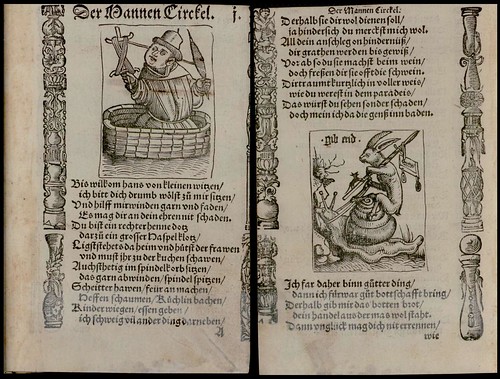
man in tub unravels yarn AND rabbit as jockey on snail


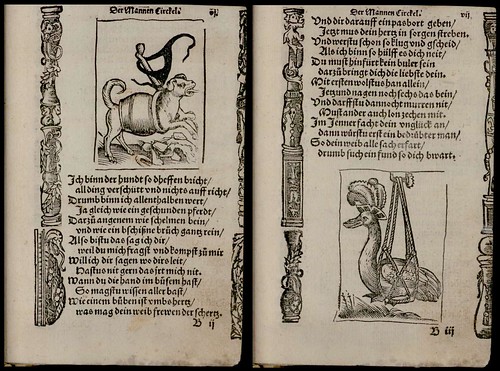
dog in cylinder AND hat-wearing goose hanging in bag


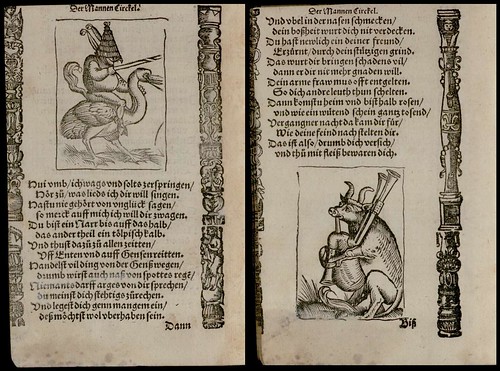
man rides bird AND cow plays bagpipes: 16th century woodcut illustrations


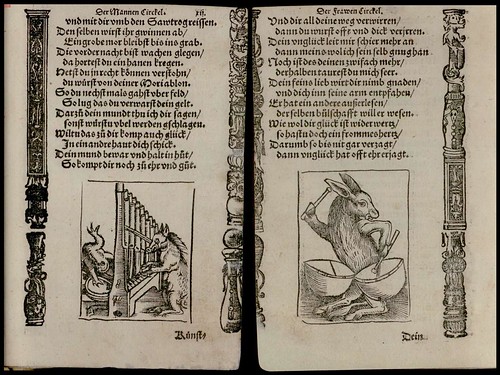
swine plays organ, frog plays drum AND ass plays drums


absurdist woodcuts from Kurtzweil by J Wickram 1550 e


absurd satirical illustrations featuring jesters or fools


armored rabbit waves flag AND goat plays lute


woodcuts: 4 absurd anthropomorphic satires


Jörg Wickram (~1505-1562) was a German writer from the Alsace region (now France) who straddled the Renaissance and Early Modern periods of literature development.

Wickram's versatile output ranged from translation work (he translated Ovid without knowing any latin) to poetry, dramatic narratives and collections of humorous anecdotes (Schwank) that drew influence from Sebastian Brandt's 'Ship of Fools' (1494), animal fable satires and the medieval minnesang tradition (seen here recently). Although these collected tales were popular, Wickram is perhaps best known for producing the earliest forms of the novel in German literature.

'Kurtzweil' (1550) is a lesser known work of poetry in the vernacular German by Wickram, featuring crude anthropomorphic woodcut illustrations, reminiscent of (but predating) Le Monde Renversé satires. There is next to nothing by way of commentary around online, but I think it's a fairly safe bet that 'Kurtzweil' belongs to the satirical/moral body of Schwank anthologies, prevalent in 16th century German literature.

Monday, September 15, 2008

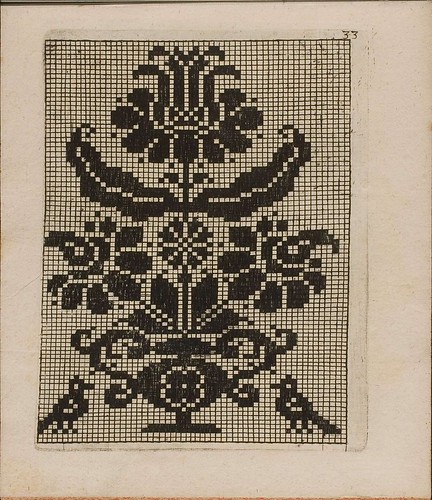
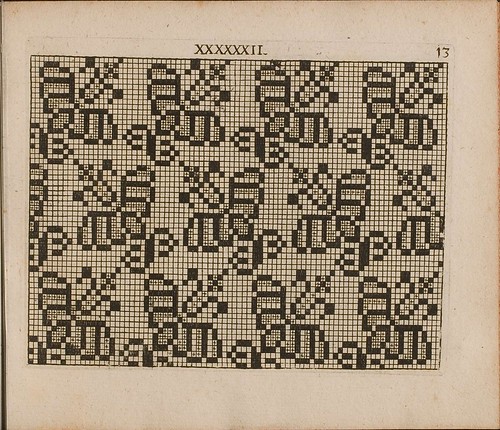
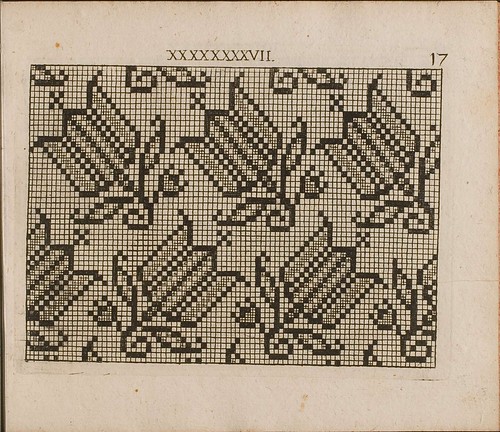
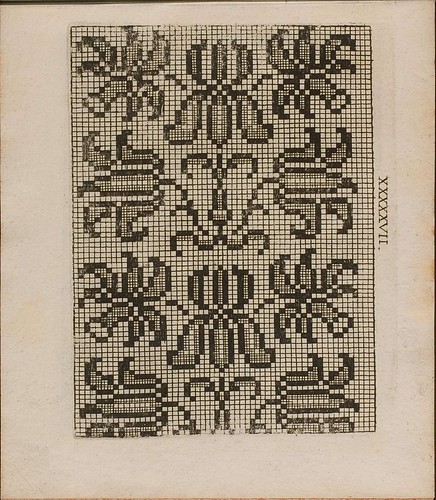
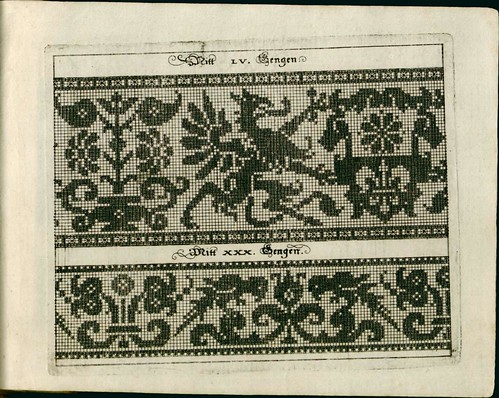
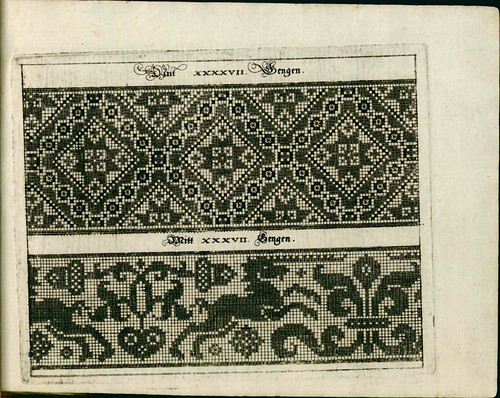
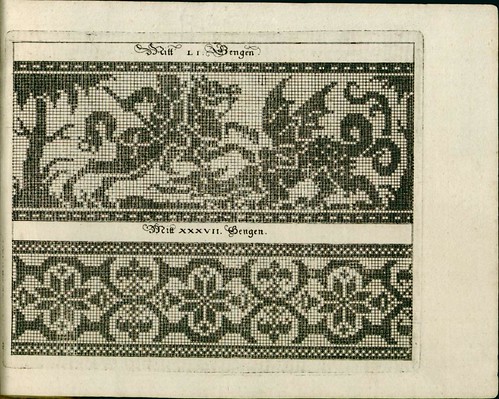
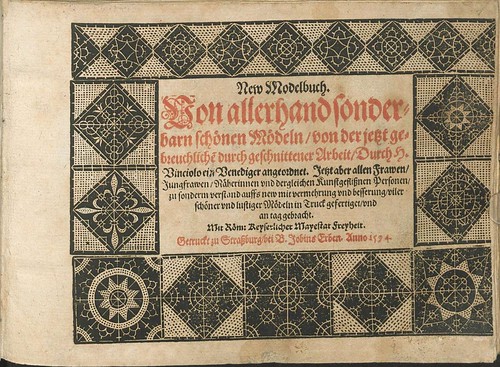
Lace Modelbuchs

The Praise of the Needle

"To all dispersed sorts of ARTS and TRADES,
I writ the Needles praise (that never fades)
So long as Children shall be got or borne,
So long as Garments shall be made, or worne,
So long as Hemp or Flax or Sheepe shall beare
Their linnen-woolen fleeces yeare by yeare;
So long as Silk-wormes, with exhausted spoyle,
Of their own Entrailes, for mans gaine shall toyle:
Yea, till the world be quite dissolv'd and past;
So long at least, the Needles use shall last.."
[John Taylor, 1640]


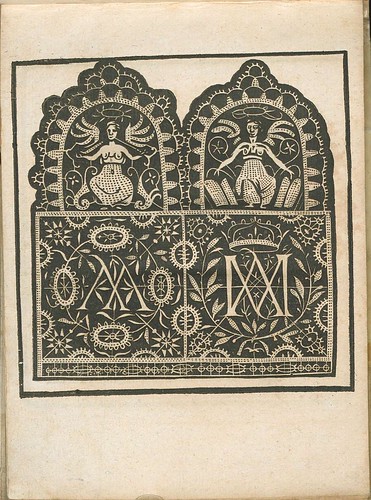
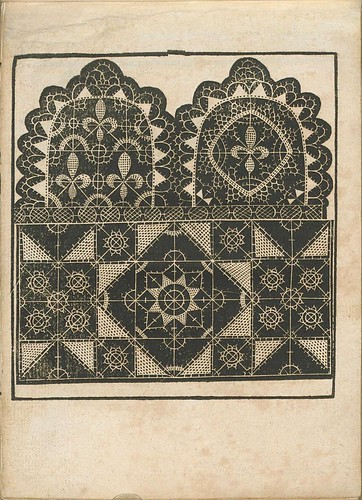
Rosina Fürst - lace modelbuch Titlepage


flower and birds design for lacemaking


lacemaking design (?)bees


flower pattern sewing


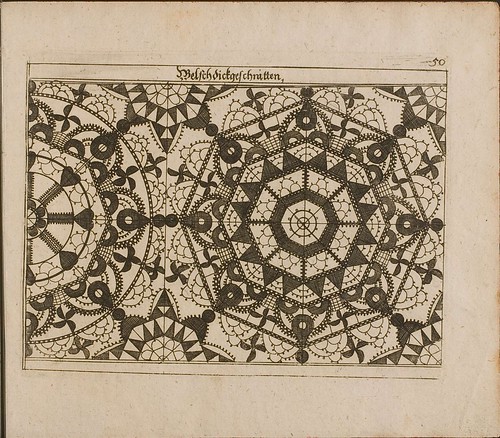
lace pattern


geometric lacemaking design


geometric lacemaking pattern


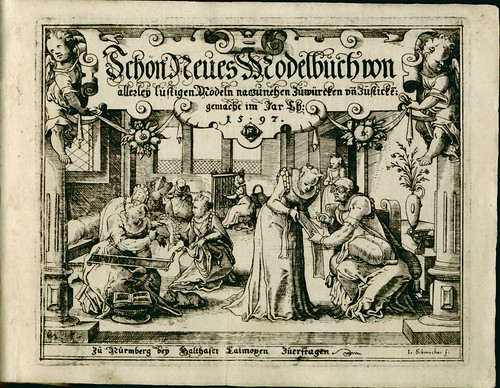
lacemaking pattern book titlepage


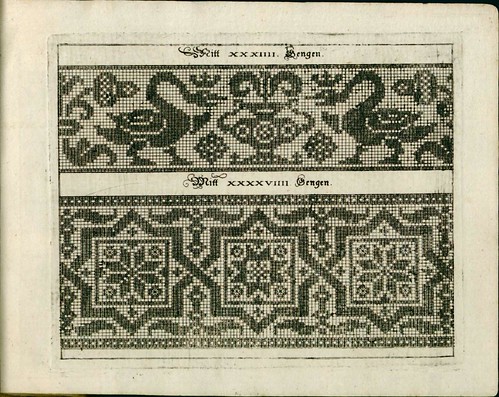
patterns with Swans

[Perugia towels with designs modelled on this pattern]


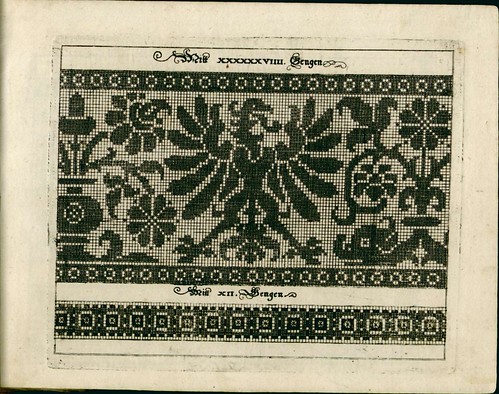
lace modelbuch - Imperial Eagle


lacemaking design - griffin


lace design with unicorn


winged dragon lace embroidery design


16th century lacemaking modelbook Titlepage


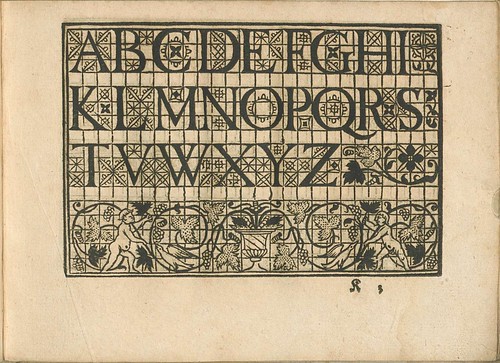
lacemaking Alphabet design


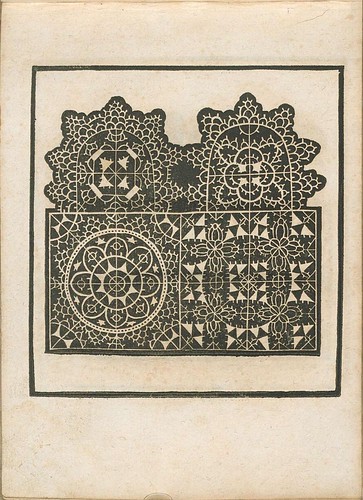
lacemaking pattern


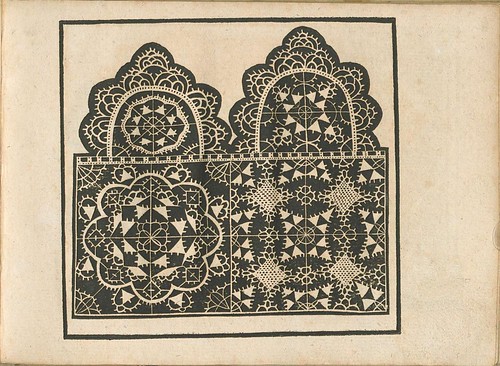
lacemaking doily design


embroidery sewing lace tapestry design


lace sewing pattern monograms


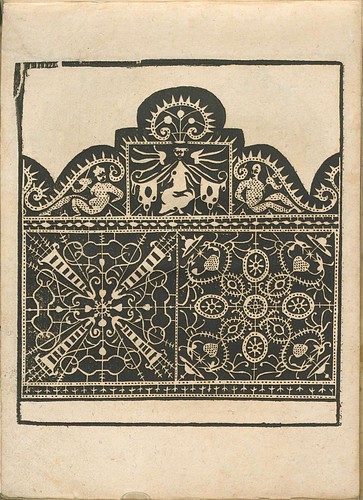
lace and sewing pattern


Oddly enough, searching for information using:
"modelbuchs, history and lacemaking for blokes who know absolutely zero about embroidery, needlework or lace and could not tell the difference between 'punto in aria' and 'reticella' if the welfare of all the children in Africa depended on it"
yields less than satisfactory background reading material. Larger, unseen forces are at work of course. I should know by now that any attempt after midnight to wrestle a totally unfamiliar topic into a couple of digestible paragraphs that have a veneer of formality and authority is bound to fail.

I have managed to glean the following: lace-making has a complex history and even from cursory reading, it very quickly becomes a matter of semantics; various forms of the craft share a common heritage with other needle-based disciplines. If we just completely skip the pre-1500 era altogether we can make the generalisation that lace work (in the physical styles and forms we all know) became popular across Europe during the 16th century.

Evidently, the first pattern book (modelbuch) featuring designs that could be sewn (?tatted) to produce lace was published during the 1520s. As with all of this genre of craft books, some of the patterns could be versatile - perhaps for use in rug-making or embroidery - while others were conceived specifically with lace-making in mind.

Needless to say, there were a number of modelbuchs released to keep up with the burgeoning popularity and, as best I can tell, the majority of these were published in the second half of the 16th century and throughout the 17th century. As can be seen in the above examples, patterns were derived from nature (flowers and animals), variable geometric shapes (sometimes derived from classical design styles) and mythological figures, such as griffins, dragons and unicorns.

Rather than embarrassing myself further by making up more balderdash, here are the links to the three - newly or recently digitised - books above...
Everything written above can be taken as code, also, that I didn't find much around that I think is worth reading on the history of modelbuchs or lace-making in general, and these books above in particular. It's just me, I'm sure. Doubtless there are wonderful resources around.

All the images above were background cleaned, to one degree or another, of age-related staining. Click on any image and then "All sizes" for a larger version.

Thursday, September 11, 2008

Collected Miscellany

Kaitai Hatsumou - lungs

Kaitai Hatsumou - anterior and posterior abdominal organ views


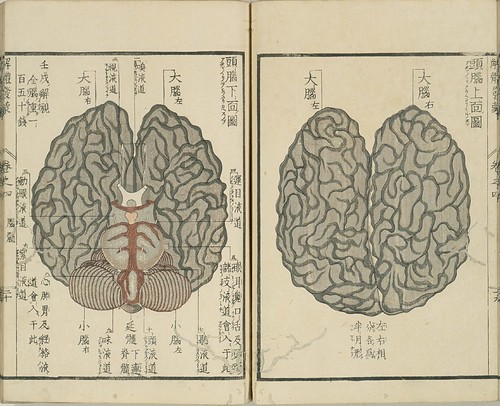
Kaitai Hatsumou - brain section diagrams

These three hand-painted woodblock prints come from a 5-volume anatomical work from 1813 called 'Kaitai Hatsumou' by Mitsutane.

The knowledge of anatomy had been given a huge boost in 1774 when the first western anatomy book was translated into Japanese. There followed a slew of publications that attempted to reconcile many of the beliefs about traditional medicine (eg. acupuncture) with the modern scientific methods. Mitsutane's work falls into this category (as best I can tell).
{The colour blue for the lungs was an interesting editorial/design decision!}
'Kaitai Hatsumou' is among the Tohoku University Medical Library Rare Books Collection which also includes that original translated 1774 work ('Kaitai Shinso').
[not to be confused with the medical science books from the Precious Books Exhibition Room at Tohoku University Library - see MA/PT]


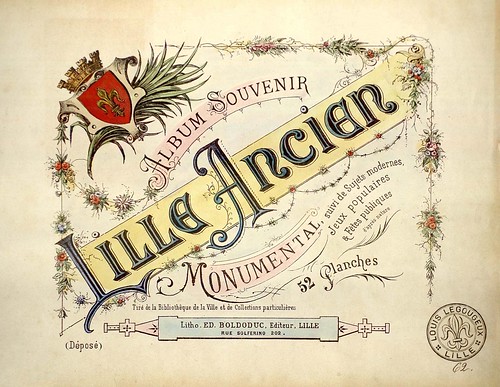
Album Souvenir - Lille Ancien - Edouard Boldoduc 1893


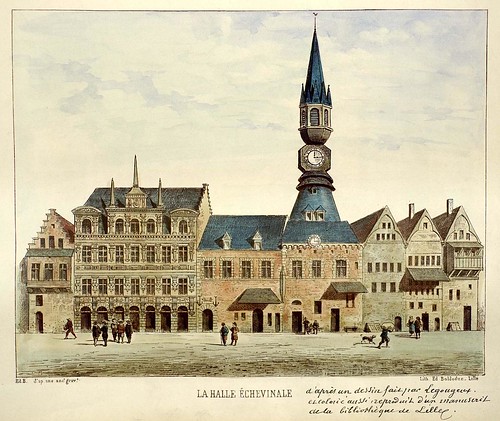
La Halle Échevinale (Lille Ancien Monumental) 1893

I think the cover is the best feature of this album of forty eight lithographs from 1893 of buildings and scenes from Lille. 'Album souvenir : Lille Ancien Monumental' by Edouard Boldoduc is available from la Bibliothèque Numérique de la Bibliothèque Municipale de Lille (the images above were extracted from pdf files but you can see all the plates as modestly sized jpeg images) I haven't looked through the entire site yet.


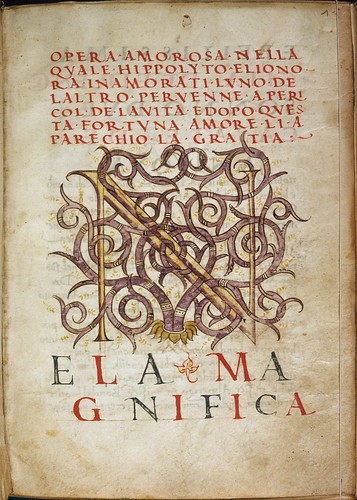
Large initial 'n' with vinework


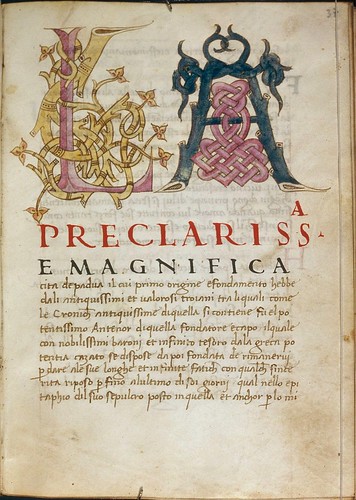
Vegetal initials 'l' and 'a'


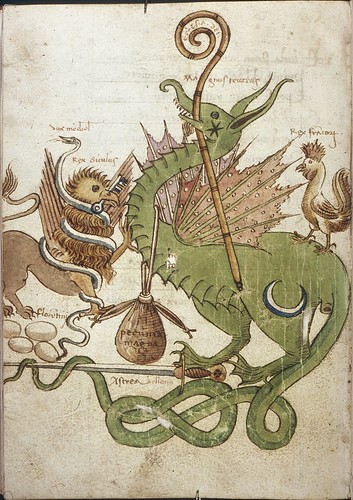
Houghton Library. MS Typ 157 Griffin, snake, dragon and rooster

These three images are from the second half of the 15th century. The first two images of decorative initials are from Houghton MS Typ 024 and the dragon/snake/griffin/rooster image is from Houghton MS Typ 157 [Houghton being the library name at Harvard University]. Both manuscripts are by the hand of the scribe/calligrapher and alchemical sonnet composer*, Felice Feliciano. *{That's going in my c.v. tout de suite}


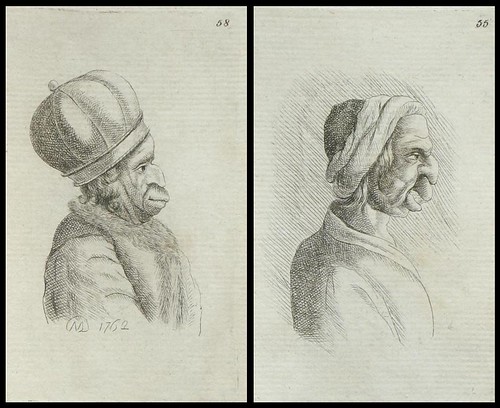
A Book of Caricaturas by M Darly 1764


A Book of Caricaturas by M Darly 1764 a

'A Book of Caricaturas : on 59 Copper Plates, with ye Principles of Designing in that Droll & Pleasing Manner' by Mary Darly (~1762) holds the distinction of being the first book devoted to caricatures to be published in the UK. The Ebay (completed) sale site would have us believe it's the only copy anywhere. I'm not sure about this but I didn't search very hard. Worldcat have a couple of citings with '60' instead of '59' in the title. There are about twenty five or so illustrations available which, in the ordinary course of circumstances, I think I would probably pass by had it not been for its publishing history. [Also: 'A History Of Caricature' 1926 by Bohun Lynch at the Internet Archive AND, very tangentially, Arthur Szyk's Berlin caricature exhibition]


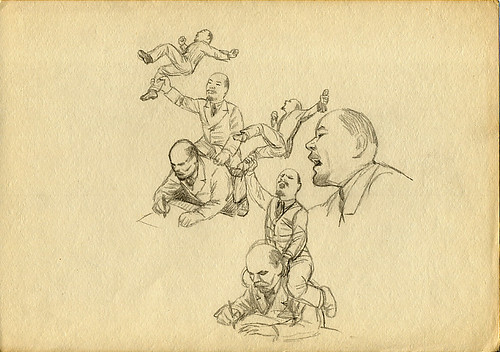
Lenin caricature

deev (username) recently posted two webpages of images - including the above Lenin drawings - taken from a trio of anonymous 1970s Kiev sketch/cartoon albums to the Art_Links LJ community. Although it helps to know Russian, there's some obvious subversive political and social commentary among these illustrations: Page One and Page Two. [via]


ventral sketch of large turtle 1792

'Historia Testudinum : Iconibus Illustrata' by Johann Schoepff', 1792 has about twenty or so plates of turtles seen towards the end of this page of thumbnails at Humboldt University.


Haeckel 1868 lecture

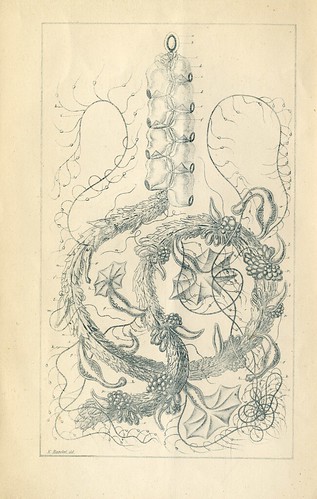
This illustration of microflora by the great Ernst Haeckel* is by far the best plate from his published 1868 lecture, 'Ueber Arbeitstheilung in Natur- und Menschenleben' at the Edoc server at Humboldt University.


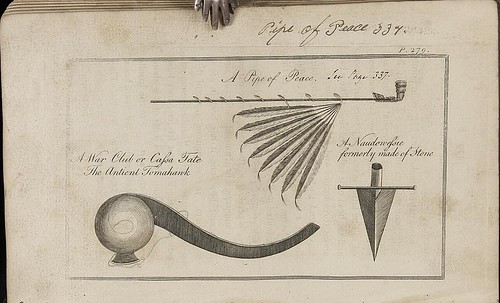
Peace Pipe and native American artifacts from the 18th century

'Travels through the Interior Parts of North-America, in the Years 1766, 1767, and 1768' by Jonathan Carver, 1778.

We are told: "Account of exploration into the interior of North America by an Englishman seeking a transcontinental waterway. Carver penetrated farther to the west that any English explorer before the Revolution. Notwithstanding the lack of substantial contributions to geographic knowledge, Howes notes that "his book...stimulated curiosity concerning routes to the Pacific, later satisfied by Mackenzie and Lewis and Clark." The remaining plate is Indian artifacts including a peace pipe." [PBAGalleries]


Memento Mori - Bills of Mortality

'London's Dreadful Visitations Or a Collection of All the Bills of Mortality For This Present Year: Beginning the 27th of December 1664 and Ending the 19th December Following'
was a publication that recorded the statistics with respect to deaths in London. At the end of the year 70,000 people were adjudged to have died from the plague out of 90,000 deaths.
"week one lists 7 fatal cases of Rickets, 8 stillborn bearths, 17 succumbing to death caused by 'Teeth', 1 victim of Thrush, 15 killed by Dropsie, 64 by Consumption, 1 executed, 29 afflicted by fever, 25 by the Flox and small pox, 2 died of apoplexie, 1 of Canker, 3 died of stopping of the stomach, 23 of simple old age"
This memento mori titlepage appears within another book, 'The Travels and Memoirs of Sir John Reresby', published in 1813 [PBAGalleries]


Sprightly Spearmen

These are the inside front and back cover pages from 'Wrigley's "Mother Goose": Introducing the Sprightly Spearmen, 1915' from the Szathmary Recipe Pamphlet Digital Collection at the University of Iowa.


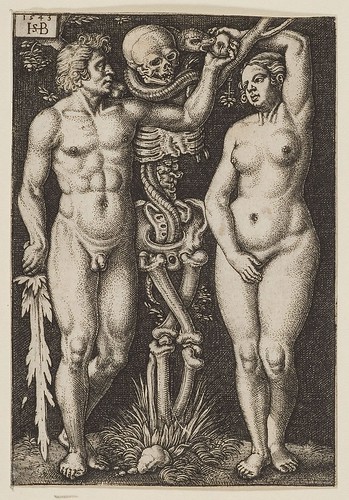
Adam and Eve by Hans Sebald Beham and Barthel Beham 1543

'Adam and Eve' by Hans Sebald Beham and Barthel Beham, 1543 at the Virtuelle Kupferstichkabinett.


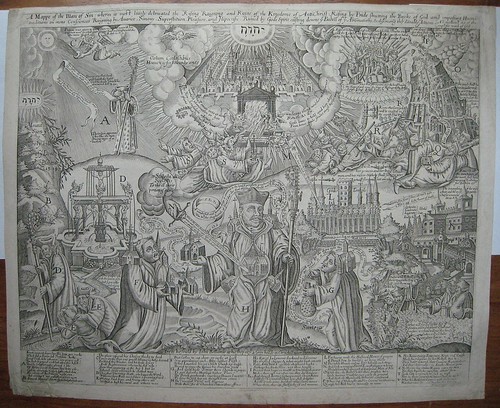
A Mappe of the Man of Sin (Princeton)

A Mappe of the Man of Sin

This complex 1622 broadside engraving (during the Reformation) that casts the Pope as the anti-Christ was the subject of a very detailed analysis last month on the British Printed Images to 1700 website. The only copy of this print is owned by Princeton University, as noted recently on their Rare Books blog.

Transcription of the full title:
"A Mappe of the Man of Sin: wherin is most lively delineated the Rising Raigning and Ruine of the Kingdome of Antichrist: Rising by Pride shutting the Booke of God and imposing Huma[n]e traditions on mens Consciences Raigning by Avarice, Simony, Superstition, Pleasure, and Hipocrisie. Ruined by Gods Spirit casting downe the Babell of their Abo[m]inations, & discoveri[n]g their da[m]nable Actions. All gathered out of the expresse word of God."


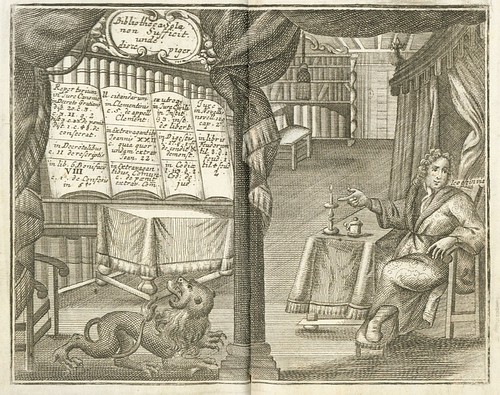
Album Juridicum frontispiece (Johann Werle, 1733) - Yale Law Library

Frontispiece from 'Album Juridicum' by Johann Werle, 1733.

"Werle's dictionary of legal maxims derived from canon and Roman law speaks to the Enlightenment-era's fondness for classification and taxonomy. [..] This must have been a useful tool for lawyers who needed to appear learned."[cite]

The image comes from Yale Law Library's Rare Books Blog where Mike Widener tells us:
"At the top of the diagram is the Latin maxim, "Bibliotheca sola non sufficit; unde disce piger", which, roughly translated, means "A library alone is not enough; learn, you lazy man!" Words to live by."


hot air balloon design


hot air balloon design


hot air balloon design

The Concours Ballons 1784 set on flickr from hulk4598 is, I am told, a contemporary manuscript of miscellaneous airship/dirigible/hot air balloon designs held by the Archives Municipales de Lyon*, France. Thanks Stéphane!


Other things...