Saturday, April 14, 2007

Karlsruher Tulpenbuch

German Tulip Book - 18th century


Tulip book from Karlsruhe


Karlsruher Tulpenbuch


1730 Karlsruher Tulpenbuch


Red flower from 1730 German Tulip Book


flowers from Karlsruher Tulpenbuch


watercolour painting from Karlsruher Tulpenbuch


18th century flower painting


Karlsruher Tulpenbuch a


Cereus peruvianus 1730


German flower watercolour 1730


watercolour from Karlsruher Tulpenbuch
The Badische Landesbibliothek in Karlsruhe (State library of Baden-Württemberg) recently posted a site devoted to the 'Karsruhe Tulpenbuch' (~1730). [thumbnail pages, multiple size image slideshow ('Bilderschau') and some large, high resolution examples ('Großformat-Abbildungen')] {via}

Karlsruhe in SW Germany was founded by and named after Margrave Karl Wilhelm of Baden-Durlach in 1715. He lived in the Karlsruhe Schloss (castle) whose baroque gardens were arranged in a concentric pattern and the 32 avenues radiating from the central tower gave rise to the circular shape of the town.

If you read german there is a lot of background available about the history of the gardens and the Karl Wilhelm family but the web translations left me more confused than enlightened. There are about 72 illustrations available (obviously not all tulips) and check out the links at the bottom of the page.

Friday, April 13, 2007

Outsider Soul

Mingering Mike


Mingering Mike a


Mingering Mike b


Mingering Mike c


Mingering Mike d


Mingering Mike e


Mingering Mike f


Mingering Mike g


Mingering Mike h


Mingering Mike i


Between 1968 and 1977 Mingering Mike produced more than 50 albums and a similar number of 45rpm singles on his own record labels. He performed for sellout audiences and wrote and starred in 9 films. This was the stuff of legends ... and fertile imaginations.

The real Mike, from Washington DC, did in fact record some songs at home with his cousins on a reel-to-reel player and even paid for some acetate pressings. His brother was the manager of a local music venue so Mike got to attend a fair number of shows that helped fuel his desire for a recording career. But that's about as far as it went. In lieu of a life of fame and fortune Mike redirected the enormous energy of his inner life into creating an imaginary career for his alter-ego, Mingering Mike.

He sketched, painted and wrote album covers and liner notes from scrap carboard, fastidiously added grooves to 'records' and made up record label names, song titles, tour diaries and included testimonial quotes from real and imagined supporters of Mingering Mike.

The obsession was also his escape during his years in hiding after going AWOL to avoid being sent to Vietnam. Some time after he resurfaced following the blanket amnesty offered by Jimmy Carter in 1977, Mike gave up his private pastime to get a real job and the Mingering Mike legacy of his youth found its way into storage.

Cue 2003 and the storage company changes hands and rather than give any leeway for late rental fees, Mike's possessions are auctioned off and the Mingering Mike collection ends up at a 2nd hand record shop in DC. An avid fringe collector, Dori Hadar, discovers the work and after intense discussion with acquaintances on the Soul Strut forums, interest from major media outlets is piqued and the real Mike is tracked down, interviewed and reintroduced to his imaginary past.

It's naive and unsophisticated certainly, and as individual pieces these wouldn't ordinarily have an artistic life beyond a suburban bedroom wall perhaps, but as a body of work the Mingering Mike collection is something of a testimony itself to all our creative inner lives and obsessions. I can relate to it as a kind of psychological quirk because it isn't pretentious or beyond the ability of most people and it's something like 'some things' I dreamt or half attempted, after a fashion, as a youngster myself.

'Mingering Mike - The Amazing Career of an Imaginary Soul Superstar' by Dori Hadar will be released by Princeton Architectural Press in a couple of weeks.

Incidentally, Mike - who has been careful to maintain his anonymity, although the book has early photographs of him - has been inspired by the recent interest in his erstwhile outsider art career and at the time the book was written had started constructing a portable record player from cardboard for his next gallery showing.

I was sent a copy of this book (without obligation). It's just under 200 pages, with a couple of essays and a description of the collection (re)discovery and subsequent meetings with Mike. It also has a large number of colour photographs of the Mingering Mike collection, from where the above images were scanned.

Thursday, April 12, 2007

Armour to Paper - On the Origins of Etching

"Repetition is not the enemy of genius, an artist can exercise
creativity by acknowledging what ought to be reiterated."
[Richard Shiff on AC Quatremère de Quincy's praise for Raphael2]
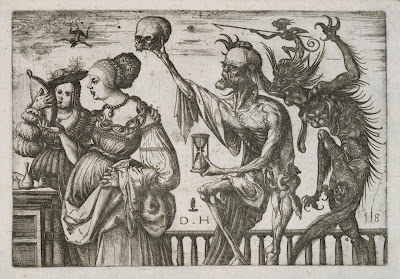
Memento Mori etching by Daniel Hopfer
Memento Mori - Death & the Devil Surprising Two Women (source)
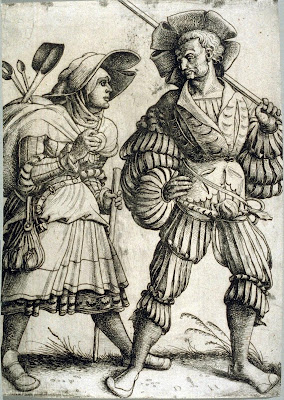

Etching of soldier and woman - 16th century
Soldier and Woman (etching on iron)

Landsknechte (renaissance mercenaries)
"The individualized soldier, the infantryman, made a late first appearance in the arts. Although wars could not have been fought without him, in ancient and medieval art he remained a notational cypher. He could not pay his way in the visual record, as could the centurion or the knight; but he was also absent because, unlike serving women, jugglers, friars, peasants and huntsmen, he was not wanted there.

Around 1500, in Switzerland and southern Germany, this conspiracy of silence was broken. In drawings and prints, glass painting and sculpture, the soldier emerged as a type, often strongly indivdualized; as a stereotype, familiar and real enough to bear a considerable weight of moral and allegorical resonance; and as a member of an occupational group whose appearance, way of life and relationships with comrades, civilians, and women were of avid if perturbing interest. By the end of the 1530s, artists had enabled us to know the soldier through visual evidence as we cannot know the practitioners of any other pursuit."
{JR Hale 'The Solider in Germanic Graphic Art of the Renaissance'
IN: Journal of Interdisiplinary History 1986 (85-114)}.
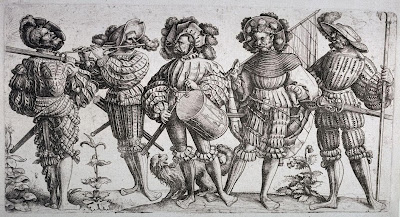

Officer accompanied by 4 soldiers etching
Officer Accompanied by Four Soldiers


Etching of 3 designs for a fountain - Daniel Hopfer
Three Designs for a Fountain


Arabesque and Satyrs
On the left: Frontpiece of architecture in 3 parts: below the Holy Family, in center the Crucifixion, and above the Resurrection and the two Apostles Peter and Paul.
On the right: Arabesque with Satyrs
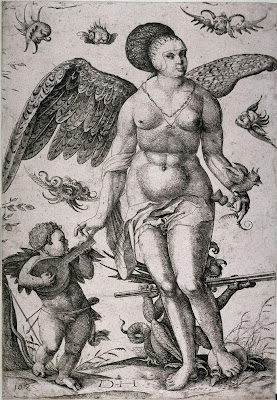

Venus accompanied by cupid playing the flute
Venus Accompanied by Cupid Playing the Lute [see also: Lute iconography]


3 old women beating a devil on the ground
Three Old Women Beating a Devil on the Ground (source)


Man embracing a woman - 16th century etching
Man Embracing a Woman


Decorative etching - Mary with Jesus
Mary with Jesus (source)


Ornamental fillet with seahorse - Hopfer etching
Ornamental Fillet with Seahorse (source)
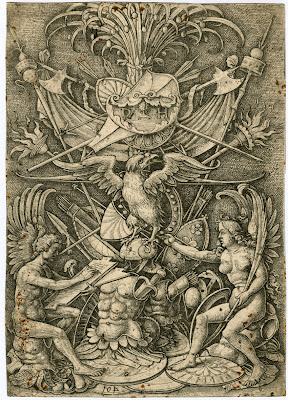

Hopfer etching - A trophy of arms
A Trophy of Arms (source)


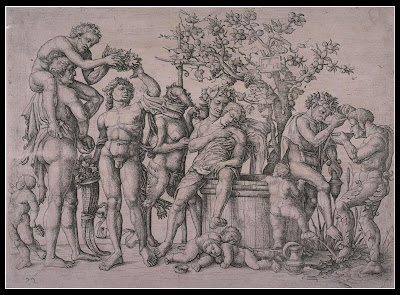
Bacchanalian scene
Bacchanalian Scene


Battle of Tritons etching
Battle of Tritons


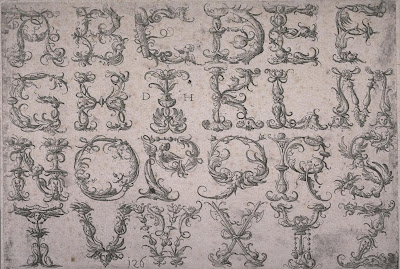
Alphabet of roman capital letters with metaphorical ornaments
Alphabet of Roman Capital Letters with Metaphorical Ornaments


Genius or simply Ingenious?

Daniel Hopfer (~1470-1536) was trained as an arms etcher at a time when Augsburg in southern Germany was one of the main centres for the production of weapons and armour in Europe.

As circumstances would have it, Hopfer was a contemporary of some of the greatest artists in german history - Lucas Cranach, Hans Bergkmair, Hans Holbein (each known as: 'The Elder') and Albrecht Dürer, among others - who were responsible for propelling Germany, in some senses, to the forefront of the Renaissance as it emerged from Italy at the beginning of the 16th century.

Hopfer's seminal contribution to this milieu was to adapt the etching technique, that he had applied to the decorative embellishment of suits of armour for an exclusive clientele, to a reproductive printing process that could distribute his artistic output to a larger population. The attraction of this new technique (originally undertaken on iron plates) was that, whereas previously an artist was reliant upon the specialist engravers and woodcut artisans to faithfully render their artistic vision in a reproducible form, etching required little in the way of specialist skills beyond competency as a draughstman. In etching, a needle is used to draw the illustration onto a soft wax ground coating which is then eaten into the plate in an acid bath. The popularity of etching would rise to challenge both the wood and metal engraving methods.
"Although the Swiss goldsmith, draftsman and printmaker Urs Graf actually produced the first dated example of etching in 1513, Daniel Hopfer, a German artist who probably made engravings on armor, is generally credited with inventing the etching process and showing it to his compatriot Albrecht Dürer, who in addition to his other talents was a prolific engraver. Dürer became the first well-known northern artist to try his hand at the new technique, producing six etched iron plates from 1515 to 1518."
The elaborate decoration of armour was most likely imported into Germany from Italy at the end of the 15th century. Rediscovered ancient Roman motifs that came to be known as grotesques as well as Islamic arabesque patterns emerged as favoured ornamental designs. Grotesques in particular, with their imaginary monsters and bizarre human figures among leafy garlands, candelabra and altars, provided a fertile decorative style for modification and reinterpretation. It was within this flux of renaissance influence that Hopfer produced both plate etchings of armour designs and armour decoration from printed illustrations. Add to this mix his fondness for emulating, modifying and borrowing from Italian renaissance art and it is not difficult to conclude that Hopfer played one of the most pivotal roles in spreading the decorative styles of the renaissance through Germany and Europe.
"On the whole, scholarship of arms etchings and other figured and ornamental arms decorations is still in its infancy. While Hopfer's contribution as a printmaker is generally acknowledged, his arms etchings are at least as important, and, like his prints, reveal the role that Italian ornamental motifs had on his transformation from a Late Gothic to a Renaissance artist. The etched motifs on the horse armour in the Landeszeughaus, for example, which were created shortly before 1510, show this important transition [figure 10]. Here he mixed intricate and fanciful Late Gothic foliate tendrils with Italianate fruit festoons that are clearly Renaissance in character."1
It was common practice (and not regarded particularly as a negative phenomenon) in the early 16th century printing environment for workshops to engage in various forms of copying: replication, imitation and hybrid adaptations. Creating and circulating printed images facilitated the spread of visual information and helped accelerate stylistic changes. And artists, who had close relationships with the workshops, probably encouraged these activities so that their works were reaching a wider audience. Hopfer had married into a family of printers so it's not surprising to find that he often (but not always) copied, borrowed from or modified works by Dürer, Mantegna, Antonio Giovanni da Brescia, Marcantonio, Flötner, Cranach and others in producing his etchings. Although he favoured illustrating decorative motifs, as can be seen in the sample images above, Hopfer's etchings incorporated visual elements from a wide variety of both religious and secular subject matter.
"By working in and between different media, Hopfer facilitated the expansion of the Power of Women topos from the margins of etched armor into the center of repeatable works on paper, demonstrating the versatility of this theme concerning sexual morality and social heirarchies and its appeal to various kinds of markets"2

Friday, April 6, 2007

Party Fish

swordfish


Trunk fish


Whip tail stingray


Flying Fish


kissing fish and lobster


Puffer fish


Spotted Lamprey


Butterfly Fish


Crab and Butterfly fish


Crab and lobster


Crabs


Dolphin Fish


Piscatorial couturier Franciscus Valentijn debuted his garish new season collection at the 1726 Nieuw Oost Indien show.

"Colour is the new scale for the smart fish set", said the beaming Valentijn. "Demure is dead. Stripes, high contrast and bold tints are where it's at."

Citing Louis Renard as an influence, Valentijn said his background as evangelist and cartographer for the Dutch East India Company gave him an opportunity to view the East Asian fashion scene first hand.

"These fish from Indonesia and Ceylon are not shy. They aren't restricted by the narrow palette of their conservative European cousins. They are colour experimentalists. I'm just trying to bring this sense of joy and vivacity to life. My collection is for the party fish inside all of us."

Indeed. We're hooked!

Thursday, April 5, 2007

The Book of Curiosities

'Kitāb Gharāʾib al-funūn wa-mulaḥ al-ʿuyūn'
(The Book of Curiosities of the Sciences and Marvels for the Eyes)

Diagram of the universe
Diagram of the Encompassing Sphere or Universe [pdf legend]
{Looks like this link won't work because of a session timer - seems you have to
click on the link below each map at the site (9 pages of thumbnails)}


Rectangular world map from Islamic manuscript
[The oldest extant] Rectangular Map of the World


Circular world map from book of curiosities - 11th century
Circular World Map


Sicily map from 11th century Islamic manuscript at Bodleian Library
Sicily Map


Sources of Nile - stylized imaginings from 11th century
Sources of Nile


diagram of winds - book of curiosities
Diagram of Winds
{from the chapter, 'On the blowing of winds, earthquakes and tremors'}


Tigris Map - river map from Islamic treatise
Tigris Map


Indus map - Kitāb Gharāʾib al-funūn wa-mulaḥ al-ʿuyūn
Indus Map


Indian ocean map - 11th century Book of Curiosities
Indian Ocean Map


Mahdiyah map - Arabic manuscript
Mahdiyah Map (Tunisia)
(this picture has been turned 90 degrees)


Arabic mediterranean map from 11th century manuscript
Mediterranean Map


Caspian sea map - Arabic
Caspian Sea Map


Illustration of waq-waq tree - Arabic folk belief
Illustration of a Waq-Waq Tree
"The Waq Waq are mythical lands, associated with trees bearing humanoid fruits, which were sometimes located in Africa and sometimes in the eastern Indian Ocean."


The Bodleian Library at the University of Oxford has launched a fascinating and detailed website presentation of 'The Book of Curiosities'.

Composed in Egypt in the first half of the 11th century, this recently discovered 12th/13th century cosmographical manuscript contains highly unique celestial and terrestrial maps, including the first known rectangular map of the world produced before the renaissance [I believe this has the first known map reference to England: 'Angle Terre']. The geographical references are based largely on the first century work of Ptolemy but the manuscript contains previously unknown distinct cartographic features.

In conjunction with the maps, the text provides insight into the customs and beliefs of the people and details about the commerce and trade routes in the Islamic Empire just prior to the start of the Crusades.

'The Book of Curiosities' is actually divided between 2 books (the universe and earth), and at the time of its purchase by the Bodleian in 2002 it was described as the most important Islamic scientific manuscript to have come onto the market in the last century. The whole of book 2 (earth) and parts of book 1 are presented in high resolution format with mouseover translations, arabic and english pop-up transcriptions as well as footnotes and map legends. I spent more than an hour just browsing around before downloading some sample images.

All of the maps (except the one I rotated) have north at the bottom. Why?

See also: cartography / Arabic.