Thursday, October 27, 2005

Dance Instruction


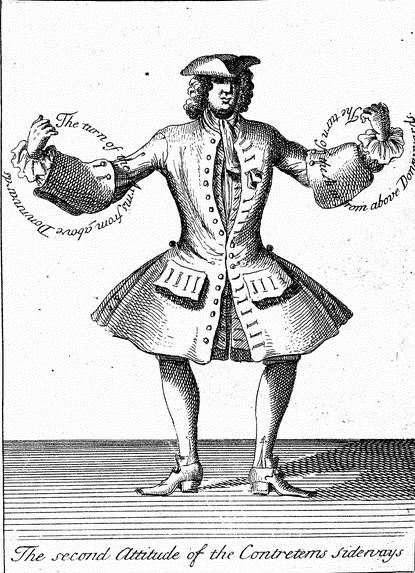
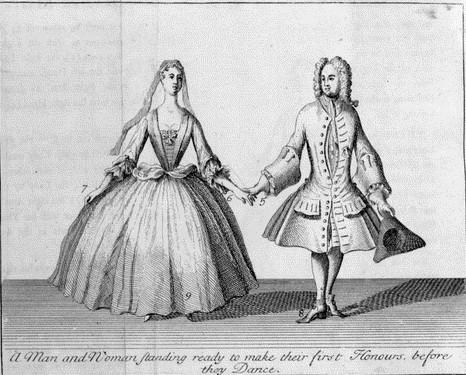
All these images come from Pierre Rameau's 1728 The Dancing Master.

An American Ballroom Companion: Dance Instruction Manuals (1490-1920) at the Library of Congress.

South African Viticulture


Khoikhoi with cattle, in Cornelius Houtman's
Account of his Journey, 1700 (unpublished).
Houtman's was the first known reference
to wine in South African recorded history -
he used red wine to barter with the Khoi.


1707 diagram of Vergelegen farm owned by
Cape Governor Wilhelm van der Stel


Title page from Cornelius Houtman's Account of his Journey.


Bartering for Supplies at Mossel Bay in Houtman's Account of his Journey.

The National Library of South Africa have an extensive exhibition, Fruits of the Vine, in which they outline the history of wine production, consumption and social and religious nuances associated with the South African Wine industry. There are many sample book images taken from their special collections department (among other display items).

Khunrath Alchemy

"Was helffn Fackeln, Liecht oder Brilln,
Wann die Leute nicht sehen wölln?"


Hermaphrodite


The Four, The Three, The Two and The One.


The Cosmic Rose


There seems to be little known about the life of German Doctor Heinrich Khunrath (1560-1605) [possibly aka: Professor Henricus Conrad Lips]. But it is clear that he held the contrary opinions that illumination could be forged through spiritual alchemy whilst asserting the importance of empirical data. It appears he pursued a sort of religious hermetical practice and his book, that popularized his beliefs to an extent, Amphitheatrum Sapientiae Aeternae or Amphitheatre of Eternal Wisdom was first published c. 1595.

There is some elucidation on the symbology behind the images here in the links below.
With respect to those images..
"The emblematic depth of the engravings Khunrath wanted for his major work put considerable demand on the artists and engravers employed for the project. The four circular plates Khunrath designed for his Amphitheatrum sapientiae aeternae, were evidently engraved by Paullus van der Doort. Of these four, we know that the drawing of the laboratory depicted here was made by the architectural painter Hans Vredman de Vries (1527-1604). Jan Diricks van Campen signed Khunrath's portrait included in the volume, and probably also engraved the title page and the rectangular folding plates included in the book."


Alchemist's Laboratory


"What good are torches, light, or spectacles,
to those who will not see?"

Wednesday, October 26, 2005

Dieting on the Busy Book


I have a strange relationship with Japanese art/bookart, as I do with the National Diet Library. On the one hand much of it has a certain familiarity about it, even dare I suggest, repetetiveness. And there is certainly a lot of it in existence (the Diet Library has 60,000 volumes online, excluding childrens' books and western books). But sometimes there is a reward if I give it time.

It is always somewhat puzzling approaching each artistic piece, without any background frame of reference or deep cultural understanding, with that ubiquitous and obscure kanji script and its hidden meanings pointing to exotic revelations if I just give it due consideration. It's a similar feeling wandering aimlessly around the esoteric Diet Library's web cloisters. I must remind myself that there is always the possibility of fulfillment if I pause long enough and look a bit more deeply.

Perhaps the lack of english is a good thing. The internet fosters a surfacey relationship. In and out in 30 seconds flat with a link or a vision from the pillage and off elsewhere for more. But with little other than the recognition of hyperlinks as a kind of architectural comfort, I feel compelled to linger when something turns up at the Diet Library. If I leave quickly I won't be able to find my way back and it may just be more deadends and catalogue redundancy ahead.
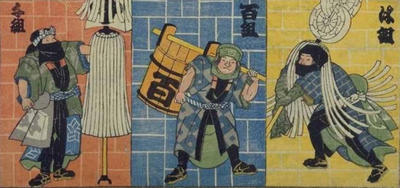

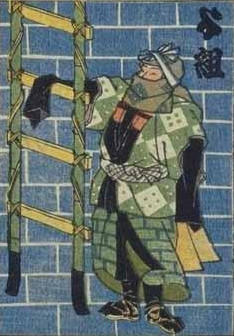
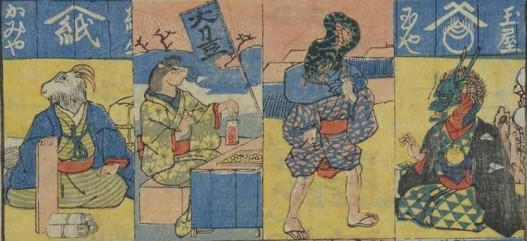
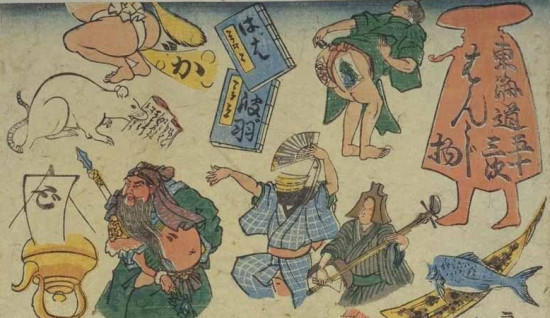
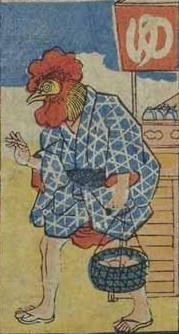
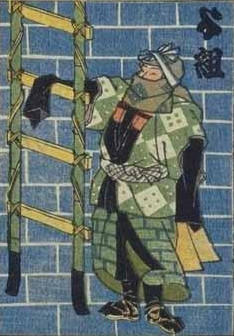
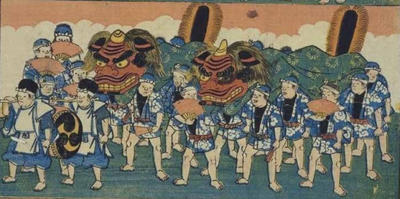
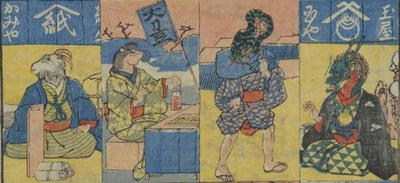
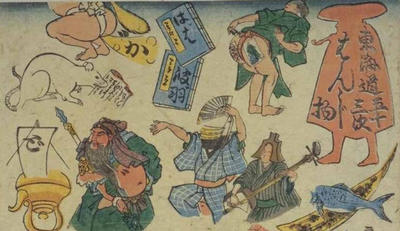
So it was in finding the Busy Book. If I recall correctly it belongs to the Edo period which lasted from 1600 to 1867. That's as much as I can tell you about the images here although I'm presuming it's a sketchbook and that they're handpainted and there's probably a few woodblocks amongst the 32 pages in the set. But if I hadn't looked closely I would have missed chickenman and the lamp ninja and somehow they made it all worthwhile.
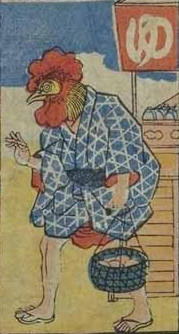

The Busy Book at the Japanese National Diet Library has pages of birds and warriors and furniture and animals and all manner of visual marvels.

Addit: Hm - that page now gives an error message, as it does (and all associated pages do) when I try to find it again using the browser history. I'm not sure if that means one must come at it via their portal or if the server is down at present. There is no way on earth I could remember how to navigate to it - I copy and paste Japanese ideograms into the search engine in a logical but ignorant fashion that is as unrepeatable as it is imponderable. Sorry about that.

Addit 2: Thanks to piranha's comment --- go to this page and copy in this: おもちゃ絵 -- click through a couple of pages (it's obvious) and you will see '32'. Click the tiny boxes next to it and voila! (I couldn't quite find the permalink) "Toy Picture" = "Busy Book" no doubt.
Leo Belgicus


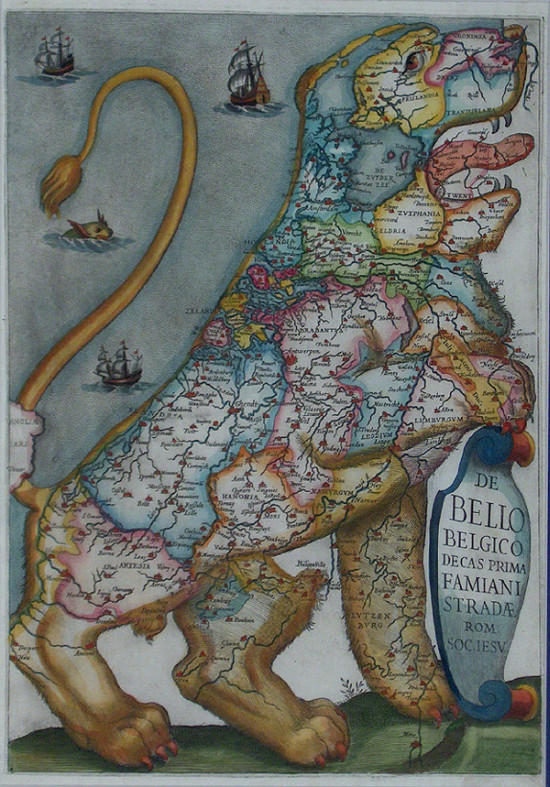
In the annals of medieval/renaissance cartography, the curious fashion of depicting the seventeen provinces of the (then) Low Countries as being part of a lion began in c. 1583. The Austrian Baron, Michael Eitzinger (or Aitzinger or van Aitzing), settled in Cologne after travelling Europe for thirty years and published his History of the Low Countries in his role as historian and cartographer to Emperors Ferdinand II and Maximillian II.

The suggestion for his Leo Belgicus probably derives from almost all of the provinces having a lion in its coat of arms. The initial map proved to be popular and various copies and derivations were published over the next couple of centuries. There were four major variants produced that took into account the permanence of the coastline feature, the changes in political status and the eventual independence gained by Holland. The above map comes from the Jesuit engraver and author Famiani Strada, whose Histoire de la Guerre de Flandres version was released in 1631.

The Quest to Marry Word and Image


Belgian Jean de Bosschère (1878-1953) was a poet, painter, art critic, author but best known as a book illustrator. Many of his projects involved books of his own, often published privately in limited editions. Into these illustrations de Bosschère poured his full artistic energies, holding them in higher regard than the prolific works he produced commercially. They approached for him the poète graphique ideal for which he aimed. His images tend towards the fantastic or even grotesque at times and they are surely evocative.


John Anzalone of Skidmore College in conjunction with the Center for Educational Technology present a website devoted to the book illustrations and artistic works of Jean de Bosschère, with primary focus on de Bosschère's own books. There really is little in the way of other information about him on the web save for the odd bibliograhical mentioning, although there are other examples of his output around.
[The works remain © Alain Bilot, heir to the estate of Jean de Bosschère's widow.]

UPDATE (June 2011): See this BibliOdyssey post (with the original images!) via the WaybackMachine.