Monday, August 18, 2008

Early Microscopes

"They were incredibly small, nay so small, in my sight,
that I judged that even if 100 of these very wee animals
lay stretched out one against another, they could
not reach to the length of a grain of coarse Sand."
[Antonie van Leeuwenhoek describes his discovery of bacteria]


Robert Hooke (1665)
From Robert Hooke's 'Micrographia' (1665)
at the National Library of Medicine [or turn the pages flash version]


Antonie van Leeuwenhoek (1673)
Antonie Van Leeuwenhoek's simplistic single-lens microscope from the ~1670s in which two screws allowed the distance from the lens and the up-and-down movement of the specimen to be adjusted. [source]


Johann Franz Griendel (1687)
Johann Franz Griendel published the first German book on microscopy in 1687. 'Micrographia Nova' was obviously greatly influenced by Hooke's classic work but it wasn't mere homage. Griendel documented significant advances in the objective lens and depth of visual field from instruments he had manufactured himself. 'Micrographia Nova' is available complete, in two sections, from the Universities of Strasbourg - Digital Old Books (SICD)


John Marshall (1700)

John Marshall's New Invented Double Microscope
for Viewing the Circulation of the Blood (~1698-1700)

"Marshall called his microscope the Great Double microscope for two reasons: he wanted to illustrate the large size of the microscope and to reinforce the fact that it was a compound microscope." [..] "One of the most significant features of Marshall's microscope was the fine focus mechanism, which was a very unique design element for the period. The mechanism functioned through a series of sleeves that attached the microscope body to the limb. One sleeve served to attach and adjust the position of the body tube to the limb, while the other moved the body tube up and down with a small focusing knob."
[By the time I removed the enormous and intrusive watermark from this image, I had *somehow* forgotten the name of the commercial art site from which it was sourced.]


Joachim Friedrich Meyen (1747)


Joachim Friedrich Meyen (1747) a


Joachim Friedrich Meyen (1747) b


Joachim Friedrich Meyen (1747) c


Joachim Friedrich Meyen (1747) d

The above images come from 'Kurzer Unterricht von der Beschaffenheit und dem Gebrauch der Vergrösserungsgläser und Teleskopien' (~Short lessons of the Constitution and the use of magnifying glasses and telescope) 1747, by Joachim Friedrich Meyen, online at SICD.


Henry Baker (1754)


Henry Baker (1754) a


Henry Baker (1754) b

From: 'Le Microscope à la Portée de Tout le Monde', the French translation of Henry Baker's 1742 publication, 'The Microscope Made Easy', available from SICD. [Googlebooks have a microfilm copy of the original]

"Simultaneously a fellow of the Society of Antiquaries and the Royal Society, Baker was a naturalist whose microscopical observations of aquatic animals and fossils were of interest to a wide audience. In 1744, his study of crystal morphology garnered Baker the Copley Gold Medal for his microscopical work and inspired other scientists to engage in systematic microscopic studies of crystalline formations. Many of the materials he examined were observed through a compound microscope made by the English optics expert John Cuff (1708-1772), which he designed at Baker's behest."
"The works of nature are the only source of true knowledge, and the study of them the most noble employment of the mind of man.... Microscopes furnish us as it were with a new sense, unfolding the amazing operations of nature, and presenting us with wonders unthought of by former ages."


Louis Joblot (1755)


Louis Joblot (1755) a


Louis Joblot (1755) b


Louis Joblot (1755) c

The above illustrations come from 'Observations d'Histoire Naturelle Faites avec le Microscope', 1754/55, available in 2 parts at SICD.

"Louis Joblot (1645-1723), a professor of mathematics at the Royal Academy of Painting and Sculpture in Paris, combined his interest in science and art through the use of a microscope. Beginning in 1716, he devoted most of his career to exposing the wonders of the microscopic world. Although not published until 1754, the illustrations and text for his Observations on Natural History Made with the Microscope were completed thirty-six years earlier."

"Joblot's instruments represented an advancement over those available before him because of the quality of the mechanisms permitting precise focusing, the excellent design of his tubular diaphragms, which eliminated stray light, and the multitude of his well-planned attachments for mounting the most diverse types of specimens." [pdf in-browser: 'Louis Joblot and his Microscopes' by Hubert Lechevalier, 1976 IN: Bacteriological Reviews {alternative link} -- well worth reading if you are into microscope/microbiology history]


Martin Frobenius Ledermüller (1768)


Martin Frobenius Ledermüller (1768) a


Martin Frobenius Ledermüller (1768) b


Martin Frobenius Ledermüller (1768) c


Martin Frobenius Ledermüller (1768) d


Martin Frobenius Ledermüller (1768) e


Martin Frobenius Ledermüller (1768) f
All the above colour illustrations come from the Martin Frobenius Ledermüller series from the 1760s, 'Phisicalisch Mikroskopische', online at SICD. The previous Ledermüller post is definitely worth seeing for the spectacular drawings of microscopic specimens and includes some biographical details. Ledermüller seems to have taken a cue from the reception given to Hooke's work from the previous century and added elements of theatricality and embellishment with the honourable intent of making the microscopic world popular and entertaining.

-------------------------


The path to the development of the microscope really began* in 11th century Iraq. The empirical scientist and polymath, Ibn al-Haytham (Alhazen), produced a massive treatise called 'The Book of Optics' in which he recorded experimental data and theories pertaining to lenses, binocular vision, mirrors and the observable properties of light. It is without doubt one of the most influential books ever written. 'The Book of Optics' outlined the rationale for practical scientific methodology that continues to resonate through every scientific discipline today. Translations of Alhazen's work circulated widely in Europe and his writings were a primary guiding source for all the major innovators in microscopy, astronomy and optical physics during the 16th to 18th centuries.
[*There's an intentional omission of references here to any ancient Egyptian, Greek and Roman observations about crystals, glass manufacturing and magnification phenomena because they don't appear to have had a direct role in the evolution of technologies that culminated in the invention of the microscope.]

Roger Bacon gave an account of the properties of biconvex lenses and their use in magnification in the 13th century. There are also ambiguous references in his work to an instrument with telescope properties. It is probably not incorrect to attribute the invention of the magnifying glass to Bacon, but as his written legacy lacks formal instrument descriptions, it is difficult to give him further credit, save for footnote status, in reference to microscope/telescope development. There is some splitting of hairs with such a conclusion. The evaluation necessitates a drift into semantics; a microscope might be said to differ from a magnifying glass (although the former, in a simple system, is an example of the latter) in that it has an applied scientific dimension -- for use in examining cells or plants etc, smaller than can be resolved by the unaided eye, for the purpose of acquiring knowledge -- rather than being a generic instrument capable of making small things appear larger. So Bacon is important in the timeline of optical physics, but slightly less so in the specific path to the production of the task-specific instrument called a microscope. This is of course open to debate. Coincidentally (or maybe not), the 13th century saw the first lenses produced as vision correction devices.

It's a fairly safe bet to assume that the quality of glass and lens production improved over the following two centuries both as a result of the heightened exchange of information during the Renaissance and because the prevalence of eyeglass makers was on the rise. Conditions, therefore, became favourable for innovation. And although the story remains somewhat murky, the balance of opinion has it that towards the end of the 16th century, the telescope was invented by Hans Lippershey and, soon afterwards, the compound microscope (an instrument with a system of two or more lenses in series) was invented - in about 1595 - by Zacharias Janssen, undoubtedly with the help of his father, Hans Janssen. Lippershey and the Janssens were all eyeglass makers and they all lived and worked in the town of Middelburg in Holland. I have no idea whether they were acquainted but what are the chances? [Attribution to Lippershey/Janssens is not universal; some sources appear to regard Lippershey as the inventor of both and others see Galileo's contributions as warranting the title of inventor. It may well be that more than one person created a functional instrument at about the same time, independently.]

Irrespective of the exact circumstances that gave rise to the invention of the microscope, the device itself or the instructions for building a microscope had arrived in Rome during the first decade of the 17th century. Galileo included both a concave and a convex lens in the compound microscope that he built, which he called occhiolino (little eye). In the early 1620s, this instrument was being used by fellow members of the venerable scientific society, the Lynx Academy. One of the Academy members, Giovanni Faber, renamed the device 'microscope'; and by the end of the decade, Francesco Stelluti (also a member), had published the first illustrations of objects - [bees: previously] - as observed under a microscope.

The first scientific paper that relied upon the findings from microscopic studies was published in 1661. The Italian physiologist, Marcello Malpighi [previously], may not be a household name, but he was the first serious microscopist and made invaluable contributions to our understanding of microanatomy. In that original paper, Malpighi recorded his observations of blood circulation in the connecting vessels - the capillaries - between arteries and veins in frog lungs which provided the vital piece of supporting evidence for the theory of the circulation of blood, postulated by William Harvey in the year of Malpighi's birth.

In 1665, Robert Hooke published 'Micrographia' [previously] to great acclaim. This lavish work introduced the science fiction-like microscopic world of familiar items - the head of a pin, the structure of a flea etc. - to a mesmerised public. It was the sensation of the age. With its sixty highly detailed plates and articulate, yet accessible essays, 'Micrographia' simultaneously motivated the world of academia to pursue experimental science with gusto and the lay intelligentsia to obtain their own instruments so they might experience similarly amazing sights as a leisure activity.

The final character of note from the early years of microscope development was almost certainly influenced by Hooke's masterpiece. Antonie van Leeuwenhoek [books] visited England in the late 1660s and thereafter devoted his life to the pursuit of lens and microscope construction. Although he published no scientific papers, Van Leeuwenhoek was a regular correspondent with the Royal Society, who granted him membership in 1680. He was renowned as an expert in producing lenses of great clarity and resolving power (to one micron), despite the majority of his microscope designs being of the single-lensed magnifying glass variety. The incredible number of lenses made during his life points to the likelihood that Van Leeuwenhoek had perfected blown glass techniques for their creation rather than continuing with the time intensive grinding process followed by the majority of his peers. But he was always secretive about his working habits and took his lens making and illumination practices to his grave. Van Leeuwenhoek is credited with the discovery of bacteria, protozoa, spermatozoa, rotifers, hydra and volvox.


[As per usual, the choice of illustrations above was largely determined by what was available/what I found and shouldn't be taken as a 'definitive illustrated guide to the history of microscopy' or the somesuch. The same goes for the text: all care is taken (hopefully) but what I've written shouldn't be regarded as authoritative. There may be intentional mistakes. Or there may not. The history is convoluted and complex and requires reading from a number of sources. In fact, I'm not sure the internet is the best place to do this.]

Calligraphy Exhibition

calligraphy

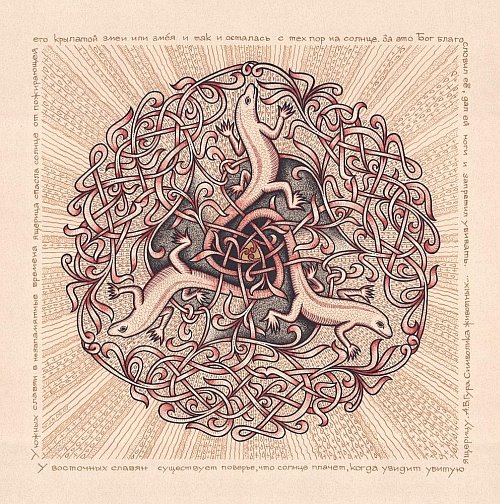
Gennadiy Vasilyevich Pavlov - Earth and Sky


calligraphy

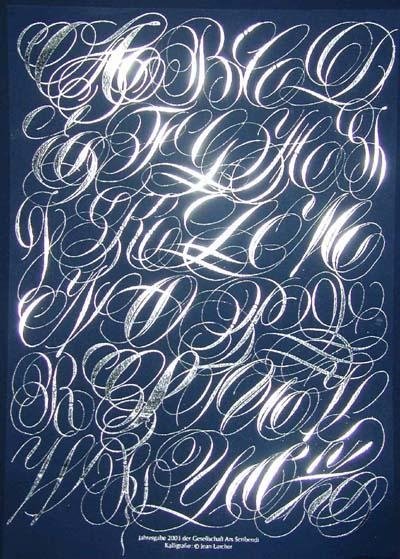
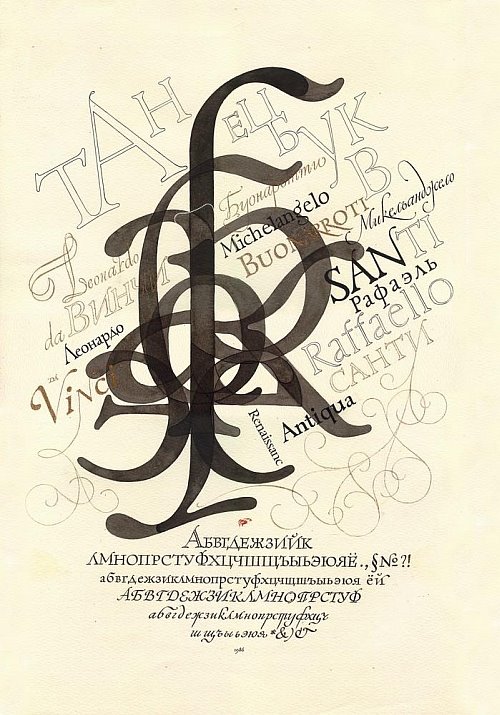
Jean Larcger - Latin Alphabet


calligraphy

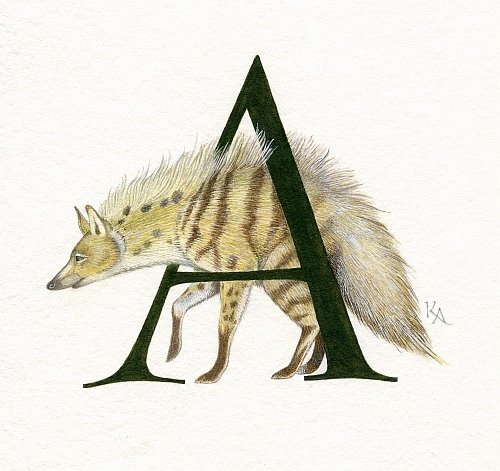
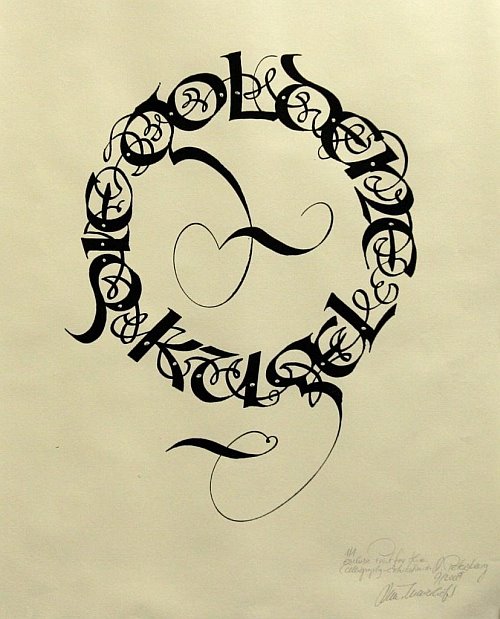
Karen Ackoff - Aardwolf


calligraphy

Çevik Savaş - Thuluth Basmala.
Signed. In the name of God, most gracious, most merciful


calligraphy

Victor Egorovich Saliev - A script sketch


calligraphy

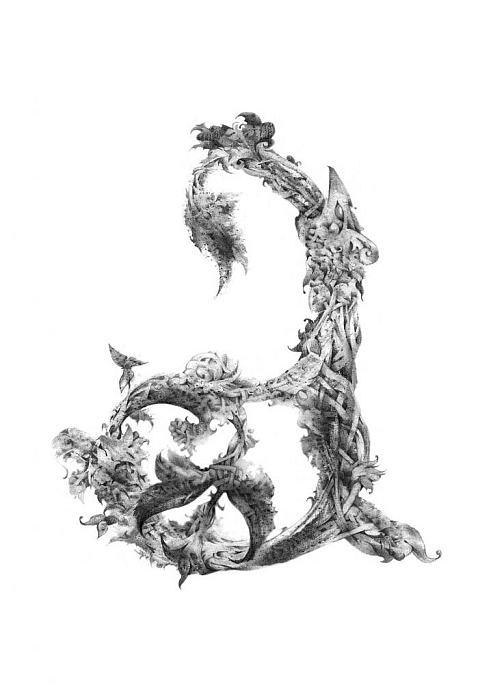
Vsevolod Petrovich Sventokhovsky - The Terratological Alphabet


calligraphy

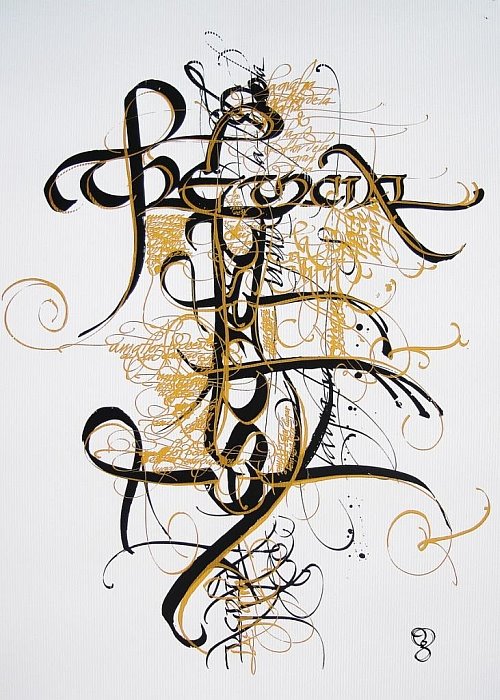
Claudio Gil
(Alterated uncial. Flora Graphica silk screen poster.
Vinilic gold and black ink on paper)


calligraphy

Gennadiy Vasilyevich Pavlov - Ognevoushki


calligraphy

Georgy Ivanovitch Kozubov - Dance of letters


calligraphy

Hans Maierhofer - The Golden Sphere


All illustrations are © the respective artist.


Click on any picture above to go through to the artist's page.

Sunday, August 10, 2008

Mélange

Dragon Tank

This fabulous dragon 'tank' comes from another volume out of the (very) weird baroque series - 'Frauenzimmer Gesprechspiele' [by GP Harsdoerffer] from HAB - that was featured here a few weeks ago.

For some reason, I got it into my mind that this engraving would be the first of many quasi-'biological tank' illustrations for a thematic entry - as if this was a hitherto secret and bizarre historical art genre (?!) - to be uncovered with a few choice image searches. Alas, the quest was largely unsuccessful, apart from the armoured war elephant image below [source]. Maybe I should have been concentrating the hunt in CG art forums. They certainly make great spaceships [via/via]


Elephant Armour


Prognosticon historicum und Physicum

'Prognosticon Historicum und Physicum..' by Johann Hebenstreit, 1565 (at BSB). There are no other illustrations as I recall. This book belongs to the Renaissance symbolist prophecy literature.


'man riding a pig' Matthias Flacius 1550

From: 'Erklerung der Schendlichen ... zum Antichrist Fallen'
~1550 by the Lutheran Reformer, Matthias Flacius* [BSB].


Skull Sundial

'Stat, und Feldtbuch Bewerter Wundtarznei' by Walther Hermann Ryff, 1551 [BSB]. This is a field manual of surgery and the skull-sundial image offers an introductory visual metaphor announcing the inevitability of death. There are many more images of instruments, surgery and anatomy within but I wouldn't describe the book illustrations as exceptional. Ryff was a prolific and respected author of 16th century medical texts. [see Morbid Anatomy for some further anatomical illustrations from another of Ryff's works]


Golden Chetodon and the Silver Fish (Ichthyologie - ME Bloch 1795) Rylands

The Golden Chaetodon and the Silver Fish
IN: 'Ichthyologie, ou Histoire Naturelle' (the French version of the original German book called: 'Allgemeine Naturgeschichte der Fische') by Marc Éliéser Bloch, 1795.
"These series of publications, under the general title 'Allgemeine Naturgeschichte der Fische', Berlin, 1781-95, 12 vols., provided with 432 excellent plate-illustrations, formed the principal work on ichthyology in the eighteenth century. But this great work, which Bloch began to publish at his own expense, would not have been finished were it not for the enthusiasm that the enterprise roused throughout Germany, it being regarded as almost a national affair; so much so indeed that all the princes and patrons of science participated in the publication expenses of the last six volumes, each plate bearing the name of the person at whose cost it had been prepared."
The plate above comes from the Rylands Collection at the University of Manchester.
The complete or near complete series is available from the Internet Archive.
Update: alternatively, the University of Heidelberg have uploaded plates from the original German version of this work (curiously, I can't find the above image): LINK.


Armadillo IN 'An History of the Earth..' Oliver Goldsmith, 1774 (Rylands)

"Oliver Goldsmith's 'An History of the Earth and Animated Nature' [1774] has been described as everything from "hackwork" to his "most substantial literary legacy"." [source] Heh. I think I would be happy to leave behind a legacy that inspired such a broad reaction. The armadillo plate comes from Rylands.


Viaduct across the Sankey Valley

Viaduct across the Sankey Valley


Manchester across Water Street

Entrance into Manchester across Water Street

I had read about 'Coloured Views on the Liverpool and Manchester Railway' by Thomas Talbot Bury (1831) which was how I came to be ferreting about in the Rylands Collection in the first place. The book was published in many editions with varying numbers of aquatint plates, but as far as I can tell, the full work has not been digitised. [see here and here]
"The Liverpool and Manchester Railway opened September 15, 1830, and was the first to use locomotive power wholly as a form of traction. The 31-mile journey took an hour and a half and cost 5/. It was a great success and spurred construction of railroads in England and abroad. The locomotive engine was designed by George Stephenson, who won a £500 prize. The artist, Thomas Bury, was a noted architect."


Skazanie - birds


Skazanie - wolves


Tale of the Rout of Mamai


The Battle of Kulikovo manuscript

'Skazanie o Mamaevom Poboishche'
(The Tale of the Rout of Mamai)

These unusual and interesting Russian manuscript illustrations come from a rare 17th century work held in the State Historical Museum* in Moscow. Scans of the manuscript were posted on the babs71 Livejournal page.

The British Library have a different version (Yates Thompson 51) with all the page images available:
"The Skazanie is a romance, composed in the 15th century, relating the struggle of the Muscovian Grand Prince, Dmitri Donskoj, against his Tartar opponent, Mamai. The central focus is the battle of Kulikovo (1380) at which Mamai was routed. The victory is presented in the context of a crusade and is couched in terms reminiscent of the contest between Gideon and the Midianites (Judges 7)."
History of Kulikovo Battle: "The Kulikovo battle of 1380 is the most important event in the history of the Medieval Russia, which to a great extent defined the further destiny of the Russian State. The battle on the Kulikovo field commenced the North-West Russia liberation from the Yoke of the Golden Horde." [also]
{thanks to languagehat for translation and background help ---- incidentally, languagehat is the co-author of 'Uglier Than a Monkey’s Armpit - Untranslatable insults, put-downs and curses from around the world': publisher; AmazonUK}


Christus Oratorium 1870 (MDZ)

This is my idea of found type: the 1870 sheet music cover from Franz Liszt's 'Christus Oratorium' [from BSB] [image has been moderately background cleaned]


'Boys Peeping at Nature' subscription ticket (Hogarth 1730) Rylands

'Boys Peeping at Nature'
subscription ticket by William Hogarth, 1830.
Notes from Rylands: "Subscription ticket, signed & sealed by Hogarth, issued to Samuel Hill in receipt of the first payment for 6 prints of 'A Harlot's Progress'. Hogarth features as the satyr lifting Nature's skirts & exposing parts previously ignored by art."


Evangelia Ottonis (late 10th cent.) Rylands

This exquisite celtic knotwork illuminated letter 'b' from the late 10th century, comes from a latin vellum manuscript known as 'Evangelia Ottonis'. The notes at Rylands mention that it is possibly Italian in origin.


German Runestone

In between contributing to the popular fairy tales of the early 1800s that made the Brothers Grimm a household name, the younger brother, Wilhelm, published a book on German rune stones in 1821 called 'Ueber Deutsche Runen', available from SICD. [previously]


Totentanz - Matthäus Merian


Danse Macabre - Basel


Dance of Death - Merian

Murals of the dance of death (danse macabre or totentanz) scenes were painted on walls in a church and a convent in Basel in the early to mid-1400s. They are important examples of the tradition since they are the link back to its medieval origins and also because they served as the inspiration for the classic iconography produced by Hans Holbein the Younger in his 'Imagines Mortis', first published in 1527.

The murals were eventually destroyed and the most faithful reproductions of the figures in those scenes were said to have been engraved by native Basel artist, Matthäus Merian, for his 1621 book 'Todtentanz, Wie Derselbe..'. As far as I know, the first full version of this work was made available online recently by the Bavarian State Library.

[see previously: Totentanz Blockbook; Heidelberger Totentanz; Death Becomes Her; Death's Dance; and also Morbid Anatomy's recent post on Holbein (via).]


Lucifer by Balthasar Caymox)


Lucifer (detail) by Balthasar Caymox
Engraving of Lucifer by Balthasar Caymox (Caimox) after Dante's 'The Divine Comedy' from the Virtuelles Kupferstichkabinett. The print is undated but judging from a previous illustration of his seen here, it was produced in the early 1600s. These images were spliced together from screencaps. [previously; also: see this Monster Brains post for more Dante devils from a 14th century Bodleian manuscript]


Other things...

Saturday, August 2, 2008

Dogs of War

Satirical Maps of the First World War

Hark! hark! the dogs do bark!
The beggars are coming to town
Some in rags and some in jags
And one in a velvet gown [Trad.]1,2,3


Hark! Hark! The Dogs Do Bark! 1914
"Hark! hark! The dogs do bark!"
(note by Walter Emanuel; London, G.W. Bacon & Co. 1914)


"The Dogs of War are loose in Europe, and a nice noise they are making! It was started by a Dachshund that is thought to have gone made -- though there was so much method in his madness that this is doubtful. [NOTE FOR THE IGNORANT: The German for Dog is Hund. The English for German is Hun. Dachshund means badger-dog -- and he is sometime more badgered than he likes.] Mated with the Dachshund, for better or for worse, was an Austrian Mongrel. By the fine unwritten law of Dogdom big dogs never attack little dogs. There are, however, scallywags in every community, and, egged on by the Dachshund for private ends, the Mongrel started bullying a little Servian. And the fat was in the fire, for the little Servian had a great big friend in the form of a Russian Bear, and he stood up for his pal. And that was what the Dachshund wanted. He hoped that a big row would ensue, and in the confusion he intended to steal a bone or two that he had his eye on for some time. He got what he wanted -- and a little more. For the Russian Bear had friends too. There was a very game little Belgian Griffon, and there was a great big French Poodle, a smart dandified fellow, and there was a Bulldog. Rather a sleepy chap this last one, and the Dachshund despised him because he was not always yapping and snaring. But the Bulldog has a habit of sleeping with one eye open, and, when he is roused, he grips and won't let go.

The Dachshund started by attacking the Belgian Griffon, as being the smallest, and mauled the poor creature cruelly, but was quite unable to kill her. And he was mistaken as to the others. He found that the dandified Poodle could fight, and that the Bulldog had not lost the knack of not lettinggo, and that Russia, after all, was a Rusher, and soon the Bear idea made the Dachshund tremble. And even the little Servian gave the Austrian Mongrel some nasty bites, and so did a neighbour of his named Monty.

The Dachshund now began to look round for friends, but they seemed strangely scarce. He had relied on an Italian Greyhound, a thoroughbred, named Italia, but Italia dissembled her love in the strangest way, and asserted that War was a luxury which she could not afford just now. All the same Italia loaded her gun, and who knows but what it may go off and whom it may go off and, whom it may hit -- for accidents will happen in the best regulated families. The Dachshund, to his annoyance, found only one friend, and that was a dog of Constantinople. The Dogs of Constantinople are quite well known for being fond of offal.

Meanwhile the rest of the European Happy Family looked on, and who shall say how the row will spread? There's the Greek with his knife ready to take a slice of Turkey; there are the Balkans determined not to be baulked of their own little ambtions; there's the Spaniard fond of Bull fighting so long as he is not a John Bull; there's the Portugee just spoiling for a scrap; there's the Swiss suffering from cold feet; there's the Dutchman, who keeps smiling with difficulty -- still some nice meaty bones may come his way, and in any event he may be relied upon to play the game and not to be a Double Dutchman. [ANOTHER NOTE FOR THE IGNORANT:-- Holland used to be known as a low lying country, but this title has now been filched by Germany] And, up North, the Norwegian, the Swede, and the great Dane all have their eyes well skinned.

All this, and more, may be seen depicted above. Search well and you may find many things. But not Peace. Peace has gone to the Dogs for the present -- until a satisfactory muzzle has been found for that Dachshund. Meanwhile the Dachshund's heart bleeds for Belgium -- and his nose for Great Britain."


European Revue (Kill That Eagle) 1914

European Revue - Kill That Eagle
(by J. Amschewitz; London, Pub. by "Geographica", 1914)

An identical map (but with more text) was published in Germany in 1914 (see VADS):
"Of great collecting value! European revue. Kill that eagle. [..] This satirical map of Europe is 'a document proving the perfidy of Albion'. Whilst German assets and blood fight for the fatherland, England regards the war merely as business by saying sneeringly: 'Business as usual' [..]. The map reproduces the English original exactly. The few words are transposed into German for better understanding. The price of this map in London is 1 shilling - 1 mark. Reproduced by a German printer without kind permission from our English cousin, as an eternal memento. Printer and Publisher W. Nölting, Kaiser Wilhelmstr. 93. HAMBURG 36."


Humoristische Karte von Europa im Jahre 1914

Humoristische Karte von Europa im Jahre 1914
(by K. Lehmann-Dumont; Leutert & Schneidewind, Dresden, 1914)


Humorous Map of Europe
Germany. The German Michel (ie. Michael, used like Johnny in “Johnny Rebel” to mean a straight-shooting fellow) has put on the war helmet over his cap and stretches and expands at full strength, already has the Frenchman by the throat and duly beats the hide of the Russian bear. The Imperial Nobility “lets its bees out of the German hive in surprising numbers against the enemy.”

Austria-Hungary fights cunningly against Russia and Serbia and kicks Montenegro in the back. With enthusiasm and unity, all its peoples go after the Russian bogeyman.
France in retreat calls to England for help, its Turkos (?) ask for pardon, while the Gallic rooster crows about victories according to the recipe from 1870/71.

Russia with an “Angel of Peace” cockade gruesomely opens its maw to swallow Germany and Austria whole, swings the Vodka bottle and the whip of revolution, while the German “insects” probe his hollow tooth and knock out his poisonous fang. The Russian bear, eager for the German beehive, is driven off by the bees, while the Pole sticks it to him, and Finland calls for a liberator.

England, having caused Egypt to declare war as well, makes its first acquaintance with the gauntlet (lit.: armored fist) while standing on its bags of money. The Indian snake gives its bulldog breathing difficulties, and Ireland tries to sever the twisted cord.
Belgium, whose people shows itself to be a poisonous toad, has already been skewered on the German fixing pin in order to be incorporated into the German collection.

Serbia, which ignited the world war with its murder-bomb, is hunched over caught by both ears by the Austrian double-eagle.
Montenegro. The fat Nikita foolishly fights against Germany and Austria-Hungary and jubilantly receives Russian rubles for his effort.

Italy, bound by the Triple Alliance, waits in his boot for the moment to intervene, armed and provided with sardines.
Spain. King Alfonse counts his war chest, his family is against unnecessary expenses, while the knight Don Quixote already raises his lance.
Portugal leans comfortably against Spain while reading the war reports.
Holland is impolitely interrupted during breakfast as a stray bomb lands in his cup of cocoa.
Denmark peacefully makes butter deliveries to German, the bayonet point of 1864 has been made safe.

Norway, as a friend and brother of Germans, applauds us.
Sweden watches developments in Russia closely and in arms.
Switzerland watches the world conflagration in all comfort and is already an asylum for homeless Russian grand dukes.
Rumania energetically forges its sword.
Bulgaria. Ferdinand busily washes his saber, still bloody from the Balkan War.
Greece, with its conquered bit of Turkey, cleverly considers its next action.

Albania. The “Commission” persists in waiting in quiet prayer.
Turkey. The sultan, wounded in the Balkan War, is recovering on his sickbed, but is not averse to giving Russia a light, which would cause the south-Russian powder keg to explode.
Japan is dragged into the European theater of war by England and grimly bares his predator’s teeth to Germany.


Het Gekkenhuis (Oud Liedje, Nieuwe Wijs) 1915

Het Gekkenhuis (Oud Liedje, Nieuwe Wijs)
{approx: The Insane Asylum (Old Song, Newly Wise (or 'new tune'?)}
(by Louis Raemaekers; Amsterdam, Senefelder [pub.] 1915)

Louis Raemaekers (1869-1956) was one of the most famous cartoonist/caricaturists of WWI. He crossed the border from Holland into Belgium to witness first-hand the atrocities of the advancing German army. He subsequently chronicled the brutality of theses forces in his cartoons which drew the wrath of the Germans. They forced the Dutch authorities to put the illustrator on trial for jeopardising the neutrality of the Netherlands (acquitted). A reward was offered by the Germans for Raemaekers' arrest and he escaped to Britain where he continued to skewer the German army in his drawings. He produced a thousand cartoons during the war and gained world wide acclaim from their syndication. {see: bio; books}


Karte von Europa im Jahre 1914

Karte von Europa im Jahre 1914
(by W Trier; Berlin, 1914)

England hides its fleet under the skirt of home, the dog Ireland is at its back.
King Oskar of Sweden looks “intently” at Russia.
France bravely retreats, while Spain devotes itself to sweet “idleness.”
Belgium – already has!

German and Austria-Hungary strike solid German blows on all sides.
Good “will” prevails in Switzerland.
|(blacked out)[Italy is loyal until death or victory(?)]|
Sicily – volcanic soil, but otherwise quite quiet.
Montenegro – a pack of lice.

Serbia – a pack of swine! The King of Derazzo.
Albania – abandons its people.
Greece and Turkey are eager to devour one another. Ferdinand of Bulgaria would also like to have a share.
|(blacked out) [(a name here?) of Rumania]|
{? Romania: King Carol I}
Russia wants to swallow up everything, but will not succeed.


Satyrische Europa Karte 1914

Satyrische Europa Karte Weltkrieg 1914
{Satirical Map of Europe in the World War 194}
(by E Zimmerman; Hamburg, W. Nölting [pub.], 1914)

The Russian bear sprays insect repellant on the Russians and holds out his empty wallet while roaring “hunger.” Finland, chained to Russia, tries to cut itself free. The Russian is under fire from Austria and Germany. His (chamber)pot is full of victories. His uniform shows a tear in East Prussia and Lithuania.

The Austrian duly scratches the Serbs.
Rumania is at the ready.
Bulgaria is still wounded from the Balkan War.
The Turk awakes, he looks at his harem woman.
Norway and Sweden are neutral, Denmark supplies butter.

Italy has both feet in one boot and remains neutral.
The German pushes Belgium out of the way with the elbow and is at Franzi’s head.
Bordeaux becomes an asylum for the homeless.
The victories of the English and French are false, like the snakes that proclaim them. The Englishman will also soon know what 42ers are, etc. etc.


Europa im Jahre 1915

Gedrängte Frühjahrsübersicht von Europa im Jahre 1915
{approx: Compact Overview of European Spring, 1915}
(by Lucas Gräfe; Hamburg, AK [pub.], 1915)


Sommerschau über Europa 1915

Sommerschau über Europa 1915
{Summer Review of Europe, 1915}
(by Lucas Gräfe; Hamburg, AK [pub.], 1915)


[Click on any map above & select 'All Sizes' for a larger version]

====================


The emergence of modern nation states (such as Germany and Italy) following the mid-19th century revolutions in Europe provided geopolitical material for satirical illustrators to exploit.

Maps that featured regional stereotypes, animals and assorted symbolic imagery and mythical and historic figures associated with particular countries became a popular vehicle in which prejudices, humour and political commentary could be assembled in a visual format.

The rise of the serio-comic map caricature genre, that had really begun in about 1870 (although the roots of the tradition stretch back at least to Munster's 'Geographica'** from the mid-1500s), reached its peak of popularity at the beginning of World War One.

The humorous propaganda maps stirred nationalistic fervour, mocked and belittled enemies and even served as a mnemonic tool for students to learn their geography. In many of the above maps you can see that the more distorted or grotesque depictions are saved for the least favoured nations while the home side is of course rendered as normal or heroic. The style declined in popularity as the war dragged on and film and posters became the more dominant media of propaganda.

While it may relate to satirical cartoons in general rather than to maps specifically, this quote below (not my translation) nevertheless conveys some sense of the changes that occurred with the propaganda drawing over time during the war:
"As early as 1910, German caricature, influential amidst a flowering satirical press, took note of raising international tensions. With the start of hostilities in 1914, the satirical press threw its full weight behind the German war effort and in aid of a fatherland under threat. Even pens that had been known for their criticism of the government followed the call by Emperor Wilhelm II for a “holy union”, and depicted the war as a defence of German culture against the onslaught of barbarism.

In their initial enthusiasm, they promoted the image of a ridiculous, incompetent, rude and cruel enemy that would almost instantly disintegrate. Russia, and to a lesser degree England, is the target of its most scathing insults; France is pictured as following the others’ lead and sometimes even as a victim of her alliances.

As the war wears on, less committed caricaturists resort to justificatory sketches, little or not at all satirical, and neither of mobilising nor inciting character, or they turn towards a inconsequential satire of cultural mores. Conservative artists continue to churn out virulently partisan material, while liberal and socialist artists, hoping for peace even while they continue to support the German war effort, introduce new characters, such as the war profiteers and the French soldier, the “Poilu”, depicted with a certain respect."


Humoristische Karte von Europa im Jahre 1914 [via]
{shame I couldn't find a better copy of this one}


Humorist - Darstellung der Wappen unserer Feinde 1914
(Humorous Illustration of our Enemies’ Coats of Arms, 1914) [via]