"There are no descriptions of persons who excite public curiosity more than those who have been ushered into notice by circumstances of peculiar notoriety, particularly such as have not been restrained by the laws of their country, or influenced by the common obligations of society. [..]
Very different are the multitude who are noticed only as instances of the deviation of nature, such as giants, dwarfs, strong men, personal deformity, &c. In like manner are distinguished those persons who have lived to an extraordinary age; others, as empirics and quacks, buffoons, prize-fighters, and adventurers, serve but to fill up the class of Remarkable Characters; and if eccentricity of manners characterises another description of persons, that very eccentricity entitles them to a place in the present work."
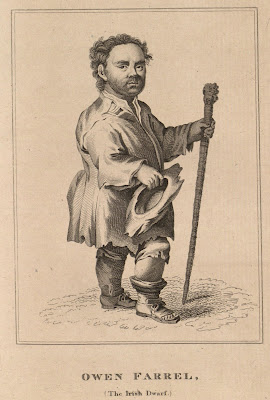
Owen Farrel (The Irish Dwarf)
"He was but three feet nine inches in height, heavy and clumsily made; and so surprisingly strong, that he could carry four men, two sitting astride on each arm; and display other astonishing proofs of his strength. He used to carry a stout staff nearly as high as himself, a fragment of a hat held out to beg, his garb ragged and dirty, holes in his stockings, and his toes protruding through his shoes. Some time before his death, he sold his body to Mr. Omrod, a surgeon, for a weekly allowance; who, after his death, made a skeleton of his bones."

Samuel McPherson

Thomas Guy (Founder of the Hospital)

Thomas Rymer

Thomas Topham (The Strong Man)

Mary Tofts (The Pretended Rabbit Breeder)
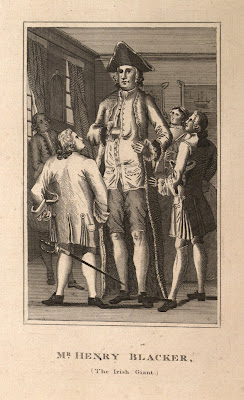
Mr Henry Blacker (The Irish Giant)
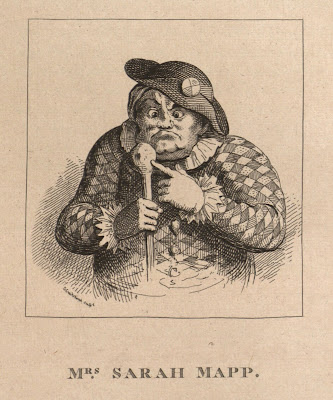
Mrs Sarah Mapp
"Mrs. Sarah Mapp, a female of masculine habits, distinguished herself by some extraordinary cure she effected, merely resulting from personal courage. She was called the bone-setter, or shape mistress. Her maiden name was Wallin. Her father was also a bone-setter, at Hindon, Wilts; but, quarrelling with him, she wandered about the country, calling herself crazy Sally. [..] In most cases her success was rather owing to the strength of her arms, and the boldness of her undertakings, than to any knowledge of anatomy or skills in chirugical operations. [..] [S]he was a character considerable enough to deserve the satire of Hogarth."
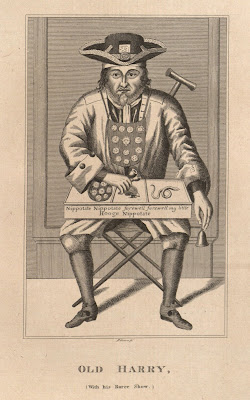
Old Harry (with his Raree Show)
"Old Harry had a facetious manner in describing the contents of his Raree-show, that never failed drawing around him crowds of auditors; his learned and elaborate elucidation on every subject, and article, contained in the attractive cabinet he was in the habit of exhibiting, became a source of amusement and instruction to old and young. And Harry contrived to make a comfortable living, at the expense of the public, in return for the trouble he took to furnish them with a species of entertainment of an interesting nature, at a very moderate charge on their pockets."

Orator Henry

Margaret Finch (Queen of the Gypsies at Norwood)
"The most remarkable [
modern Cleopatra] was Margaret Finch, born at Sutton, in Kent; who, after travelling the whole of England in the double capacity of gipsy and thief, finally fixed her place of residence at Norwood. [She] adopted a habit, and afterwards a constant custom, of sitting on the ground with her chin resting on her knees, which caused her sinews to become so contracted, that she could not extend herself of change her position. [..] The singularity of her figure, and the fame of her fortune-telling, drew a vast concourse of persons from the highest rank and quality to that of the lowest class in life. Norwood, and the roads leading to it; on a fine sunday, resembled the scene of a fair; and, with the greatest difficulty only, could a seat or a mug of beer be obtained, at the place called the Gipsy-house."

Mahomet Caratha (Turkish Equilibrist)
"Mahomet Caratha was esteemed the best rope-dancer and equilibri
est of his time; his extraordinary feats attracted crowded audiences where ever he performed; and his reputation was not diminished by the publication of his portrait, which greatly tended to increase his fame."

M. Christopher Miller (The German Giant)
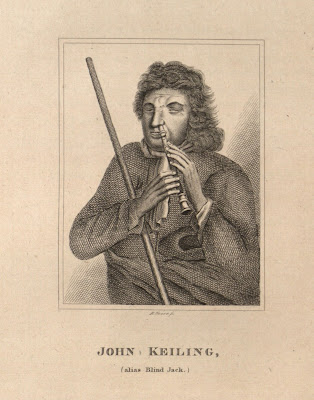
John Keiling (alias blind Jack)
"The streets of London, in the reigns of Queen Anne, George the First, and Second, were infested with all sorts of paupers, vagabonds, impostors, and common adventurers; and many, who otherwise might be considered real objects of charity, by their disgusting manners and general appearance in public places, rather merited the interference of the parish beadles, and the discipline of Bridewell, than the countenance and encouragement of such persons as mostly congregate around common street-exhibitions. One-eyed Granny and Blind Jack were particular nuisances to the neighbourhoods in which the first practiced her mad-drunk gambols, and the latter his beastly manner of performing on the glageolet - John Keiling, alias Blind Jack, having the misfortune to lose his sight, thought of a strange method to insure himself a livelihood."
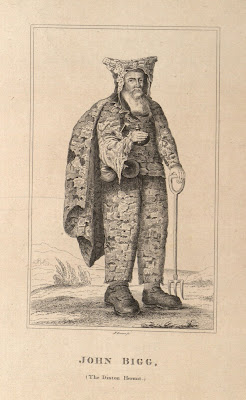
John Bigg (The Dinton Hermit)
"John Bigg, the Dinton Hermit, baptized 22nd of April, 1629, buried 4th of April, 1696. He lived [..] in a cave, had been a man of tolerable wealth, was looked upon as a pretty good scholar, and of no contemptible parts. Upon the restoration he grew melancholy, betook himself to a recluse life, and lived by charity, but never asked for any thing but leather, which he would immediately nail to his clothes. He kept 3 bottles that hung to his girdle, viz. for strong and small beer, and milk; his shoes are still preserved; they are very large, and made up of about a thousand patches of leather."
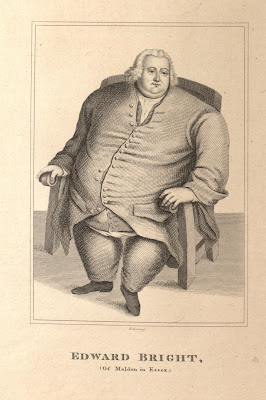
Edward Bright (Of Malden in Essex)
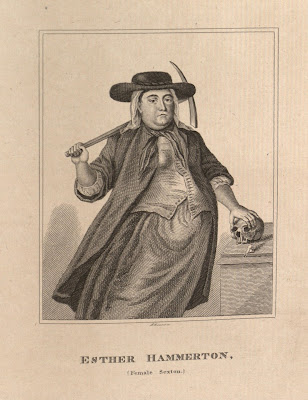
Esther Hammerton (Female Sexton)
"She was a woman of a strong and robust constitution, of a good countenance and complexion; but at the time the chapel fell on her, she received a hurt which prevented her ever afterwards from wearing stays. Her usual dress, in consequence, was a man's waistcoat and hat, a loose long gown, and a silk-hankerchief tied round her neck; but on sundays and holidays she would dress extremely neat and clean, in a gown of the best fashion, a mob-cap, with a frilled border, gay ribbons, and a nosegay in her bosom. She studiously avoided every sort of female employment; but was particularly partial to all kinds of manly sports and pastimes, as cricket, foot-ball, bull-baiting, sliding, skaiting
&c.; frequenting most of the country-clubs, and joining in the smoaking, drinking and singing, of every convivial party she entered." {1711-1773}

Henry Evans (born 1606)
"We cannot much wonder at the hardy sons of Wales living more than a century, upon their mountains; but Mr. Henry Evans, transplanted from Cumbria, certainly resided in Spital-street, Spital-fields, London, yet reached the still greater age of one hundred and twenty-nine, and retained all his faculties until the last. He was seven years old when Charles I was beheaded by the regicides; and this circumstance acertains his birth to have been 1642, and his death to have occurred in 1771."

Jane Scrimshaw
"Jane Scrimshaw is no other way recorded, than as having lived to the advanced age of one hundred and twenty-seven. Had Jane Scrimshaw kept a diary of transactions which must have passed immediately under her view, how many interesting particulars might have been recorded during the reign of eight soverigns." (1584-1711)

John Alder (Prisoner in the Fleet)
A Slave when Fifty to a rigid Turk,
With many blows, poor diet, and much work;
Enduring this for twenty years, pray tell,
D'ye think I don't look tolerably well.
1797 [A Turkish Merchant] - note:
I don't actually think he was Turkish.

Ann Mills (Served on Board the Maidstone Frigate)
"Among the female adventurers and candidates for military or naval glory, none in their time stood more forward than Ann Mills. By what chance, or in what capacity she first commenced her career on shipboard, is not known; but, about the year 1740, she was serving as a common sailor on-board the Maidstone frigate; and, in an action between that ship and a French enemy, she so greatly distinguished herself, by personal prowess, as to be particularly noticed by the whole crew. It is, by the circumstances of her portrait being taken with a Frenchman's head in her hand, that we are naturally led to imagine the service she performed must have been of a most desperate nature, or of being boarded by the enemy; and, probably, after the conquest cut off the head of her opponent, as a trophy of victory.
In all likelihood, some love affair induced this woman to assume the male character, in order to follow the fortune of a favourite lover, who had gone to sea. Mary Read and Anne Bonny, two notorious female virago pirates; Christian Davis, commonly called
Mother Ross; with Hannah Snell, which latter two served in a military capacity, all pleaded the
tender passion as an apology for assuming masculine pursuits and habits."

Bampsylde Moore Caren (King of the Beggars)
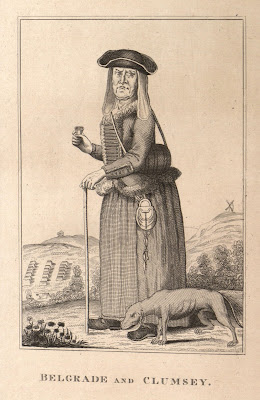
Belgrade and Clumsey

Cornelius Caton (Of the White Lion, Richmond)

Crazy Crow (Porter to the Playhouse in Dublin)
With look ferocious, and with beer replete,
See crazy Crow beneath his minstrel weight,
His voice as frightful as great Aetna's roar,
(Which spreads its horrors to the distant shore,)
Equally hideous with his well-known face
Murders each ear till whisky makes it cease.
[click images for much enlarged versions]
Known commonly as
'Remarkable Persons', the 4 volume collection of portraits and stories about the eccentrics of Britain in the 18th century by James Caulfield was issued by subscription in 1819 and 1820 to great success. It promised to satisfy the public fascination with 'true stories' about exceptional feats, physical peculiarities and notorious acts. The extent to which it actually contained 'true stories' is a matter for conjecture - note the description below the female sailor image above - no doubt James Caulfied would be eminently employable by one tabloid or another, were he alive today.
'Portaits, memoirs, and characters, of remarkable persons: from the revolution in 1688 to the end of the reign of George II collected from the most authentic accounts extant by James Caulfield' is online in its entirety as page images among the Joseph McGarrity Collection at Villanova University Digital Library, Pennsylvania.
Irrespective of the factual accuracy, this is a fantastic series just to browse through (at a great site). There are 155 engraved plates (15 by George Cruikshank) but the stories themselves are humorously oddball enough, ably assisted by the quirky language and grammar of the period.
ADDIT: A related post in August 2012 :
Eccentric Characters, from a book that's partly based on Caulfield's series.


